Return-to-Play Planning After a Sports Injury
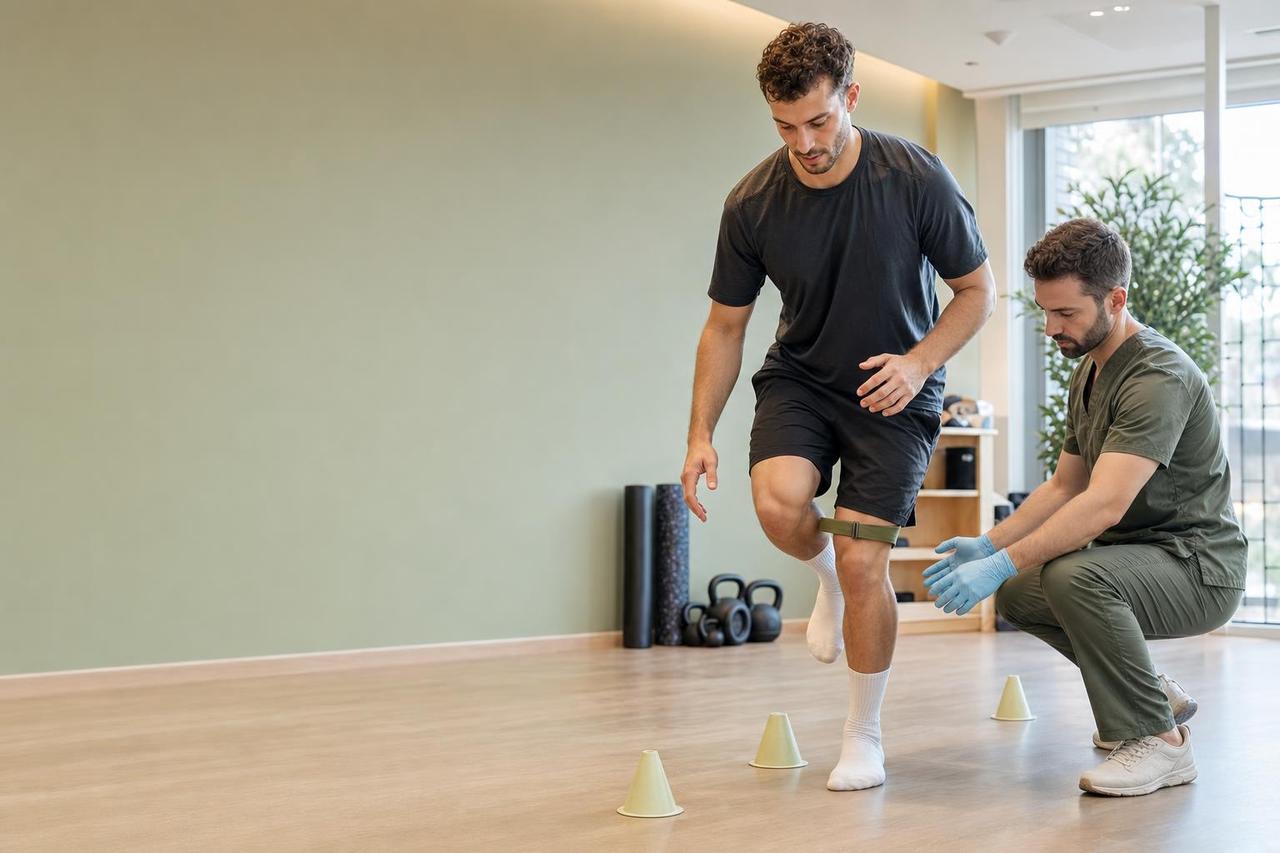
Returning to your sport after an injury should feel earned, not rushed. This guide explains how sports physiotherapy in Dubai works at every stage, from the first assessment after a strain or sprain through the strength and movement testing that signals a safe return to play, so you know what to expect, what evidence-based care looks like, and how to choose the right clinic for your goals.
Key takeaways
- Sports physiotherapy covers prevention, assessment, treatment, and return-to-play rehabilitation for muscle, tendon, ligament, and joint injuries.
- The most reliable plans combine progressive loading and strength work with hands-on care, education, and selected adjuncts such as shockwave or taping.
- Return to sport should be guided by objective functional milestones, not days on a calendar.
- A guideline-informed clinic reassesses you regularly and adjusts the plan as you progress.
- No honest clinic will promise a guaranteed cure or a fixed timeline; recovery depends on the injury grade, tissue involved, and adherence to your program.
What sports physiotherapy actually means in Dubai
Whether you train for a Friday five-a-side, a half marathon along Jumeirah Beach, padel tournaments, or just want to keep up with your kids at the park, an injury can stop the routine you have worked hard to build. We understand how frustrating that pause can be, and how much you want to come back without losing what you have built. Sports physiotherapy is the branch of physical therapy that focuses on the prevention, assessment, treatment, and rehabilitation of sports-related musculoskeletal injuries: muscle strains, ligament injuries, joint sprains, tendinitis, and overuse problems.
In Dubai, athletes searching for a physiotherapist near me, a trusted physiotherapy center Dubai, or a sports doctor Dubai usually have one of two goals: get back to training safely, or stop a niggle from becoming a season-ending issue. Both are valid reasons to book an assessment. Our team led by Dr. Mina Gamil approaches every athlete the same way, with a structured first visit that maps your sport, your symptoms, your training load, and your goals before we discuss any treatment.
Who benefits from sports physiotherapy?
You do not need to be a competitive athlete to benefit from sports injury rehabilitation. Recreational runners, padel and tennis players, CrossFit athletes, footballers, swimmers, cyclists, and gym-goers all sit comfortably inside this scope. So do desk workers who have started a new training program and developed a knee or shoulder issue. The common thread is a body being loaded for performance, and a plan that respects that demand.
Common sports injuries we assess
Injury patterns in Dubai clinics generally fall into two mechanisms: acute trauma, such as a twisted ankle or a tackle to the knee, and repetitive loading or overuse, such as runner's knee or tendinopathy from training spikes. Across both categories, certain conditions come up again and again at the assessment table.
- ACL and meniscus injuries of the knee, often from twisting or pivoting sports
- Ankle sprains and recurrent ankle instability
- Shoulder pain from throwing, swimming, racket sports, and overhead lifting
- Tennis elbow and golfer's elbow from racket sports, lifting, and repetitive work tasks
- Hamstring, calf, and groin strains from sprinting and change of direction
- Patellar and Achilles tendinopathy in runners and jumping athletes
- Lower back pain in golfers, rowers, and lifters
Why do these injuries happen? Most are a mix of three things: a sudden mechanical event the tissue was not prepared for, a gradual increase in load that outpaced the tissue's capacity to adapt, and individual factors such as previous injury history, mobility, strength balance, or technique. Understanding which of those factors is doing the heavy lifting is what turns generic rehabilitation into targeted sports physiotherapy. For knee-specific concerns, our orthopedic physiotherapy and dedicated post-ACL rehab pages explain how we structure care around the joint and the surgeon's protocol.
How a sports physiotherapy assessment works
A first visit at a thoughtful physiotherapy clinic in Dubai should feel like a conversation as much as an examination. We ask about your sport, training history, previous injuries, current symptoms, what aggravates and eases them, your goals for the season, and any imaging or surgical reports you already have. From there we test movement, strength, range, and sport-specific function, then explain what we found in plain language.
What we look for during the physical exam
The physical exam blends standard orthopedic testing with sport-specific demands. For a runner with knee pain, that might mean single-leg squat control, hip strength, calf endurance, and a look at your running mechanics. For an overhead athlete with shoulder pain, it could mean scapular control, rotator cuff strength, and a check of thoracic mobility. The aim is to identify the root cause driving the symptom, not only to label the pain.
Pro tip
Bring your training shoes, your usual gym kit, and a short summary of your last four weeks of training (sessions, distances or loads, anything that changed). The more honest the picture of your load, the more accurate the plan.
The rehabilitation phases
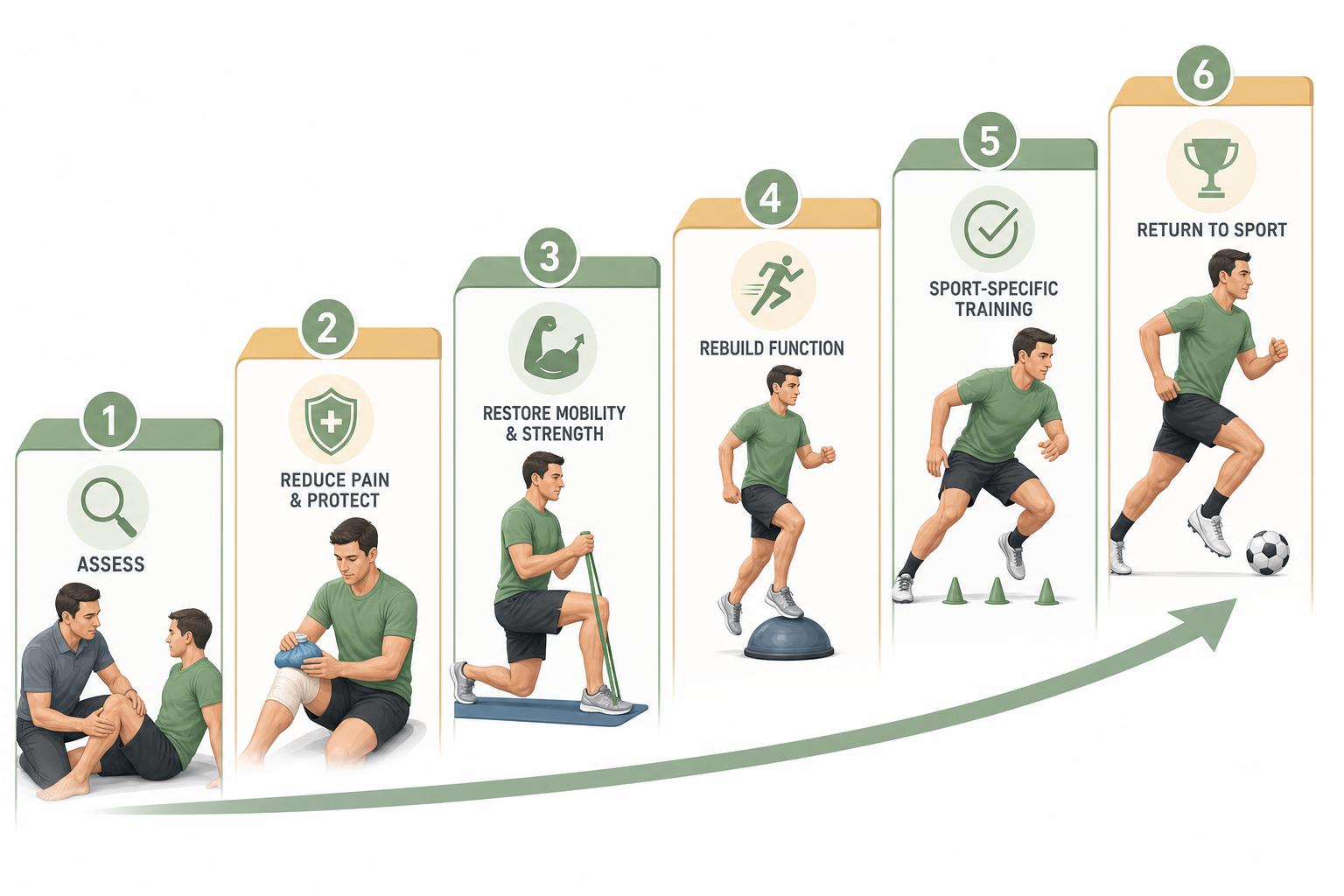
Evidence-based sports injury rehabilitation tends to flow through three overlapping phases, each with its own goals. The phases are not strict boxes; they blend into one another as you progress, and your physiotherapist will move you forward based on what your body shows, not the calendar alone.
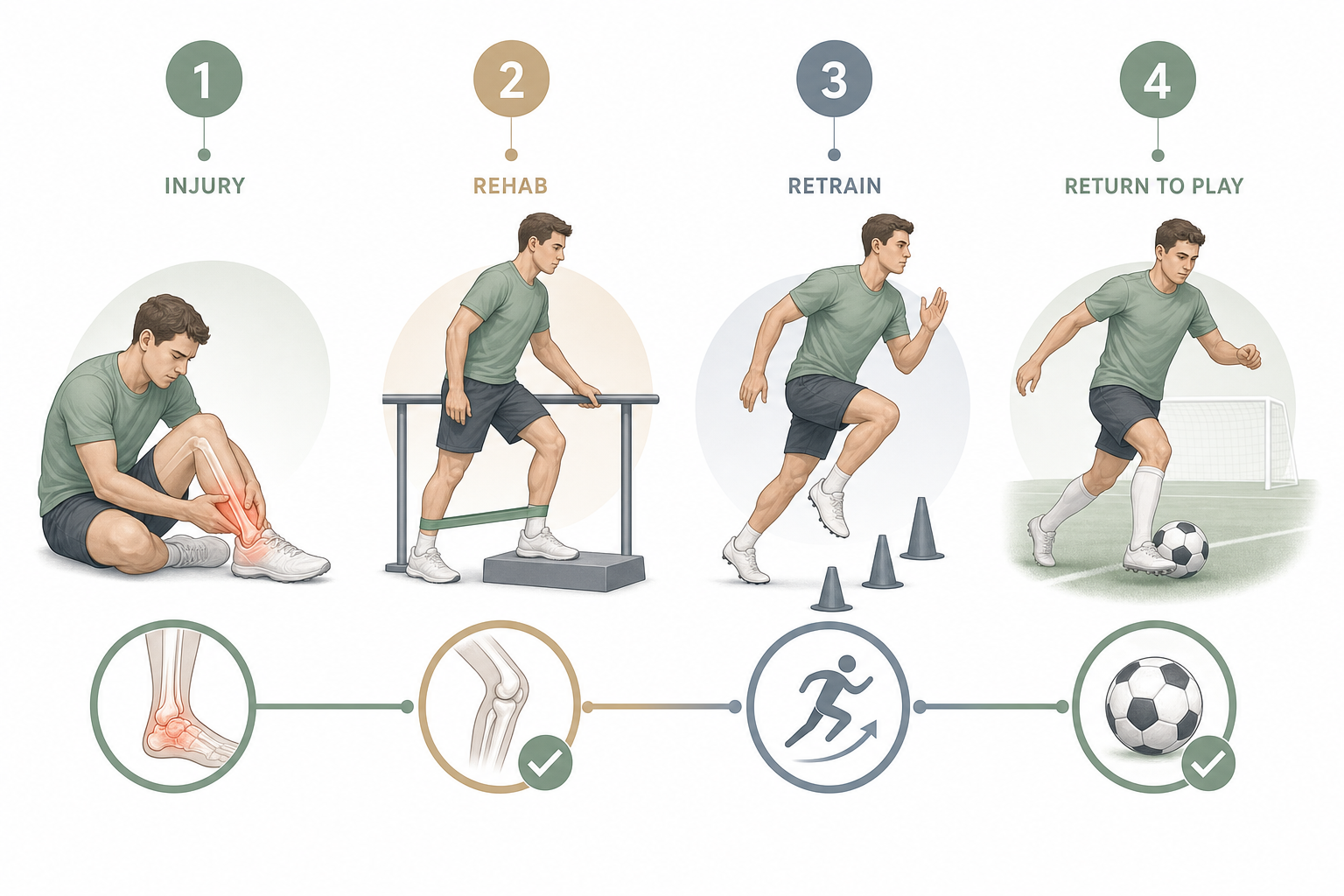
Phase one is the early or protective phase. Goals are calming down pain, protecting healing tissue where needed, restoring comfortable range, and keeping the rest of the body conditioned. Hands-on manual therapy can help joint motion and reduce pain, gentle isometric loading often starts here, and you usually leave with a home exercise program tailored to your stage.
Phase two is the rebuilding phase. Pain is more settled, the tissue is more tolerant, and the focus shifts to progressive strength, control, and movement quality. Exercise therapy is built around strength, flexibility, endurance, and function. We also use education here, on body mechanics, load management, sleep, and small lifestyle changes that influence recovery.
Phase three is the return-to-sport phase. The work becomes faster, heavier, and more sport-specific: change of direction, plyometrics, sprint progressions, sport-skill drills, and graded exposure to the demands of competition. Selected adjuncts such as shockwave therapy may be considered for stubborn tendinopathies, and kinesiology taping, sports massage, dry needling, or therapeutic ultrasound can be used alongside loading where appropriate. None of these adjuncts replace progressive loading; they support it.
Rebuilding strength and control
The strength phase is where most lasting progress is made, and where many recreational athletes get short-changed if their care stops at pain relief. Tissue capacity, the ability of a tendon, muscle, or ligament to tolerate load, is built through deliberate, progressive exercise over weeks, not days.
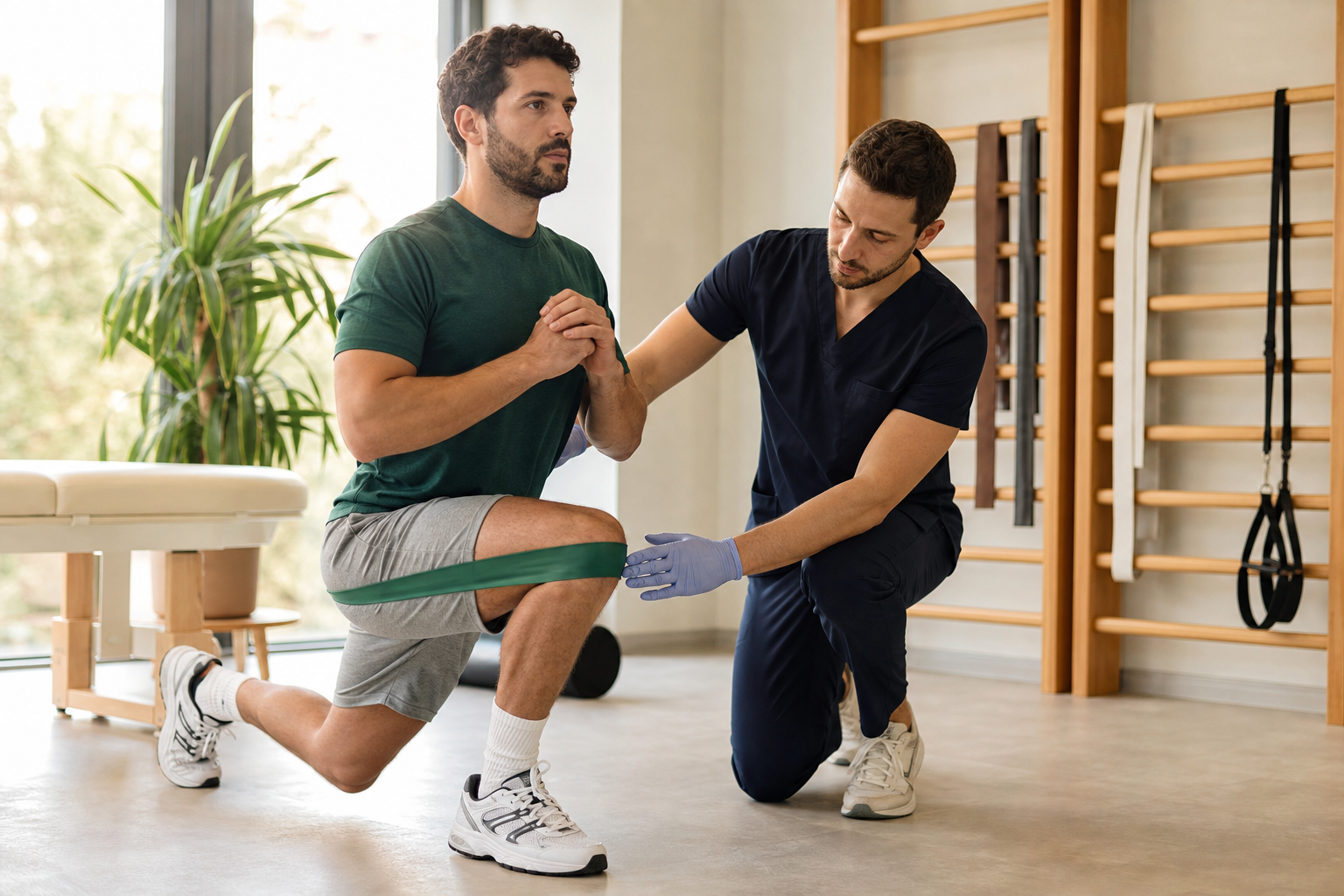
What does that look like in practice? For an Achilles tendinopathy, it might mean isometric calf holds early, then heavy slow resistance work, then plyometrics. For a post-ACL knee, the strength arc spans single-leg control, hamstring and quadriceps strength benchmarks, hopping and landing mechanics, and finally cutting and pivoting. For a shoulder, it might mean rotator cuff endurance, scapular control, and overhead pressing or throwing progressions matched to the sport.
This is also where many of our patients ask about sport massage in Dubai, sports therapy Dubai, or whether a physiofit sports & rehab clinic style of training fits in. Sports massage and soft-tissue work can be useful between hard sessions or as part of a recovery routine, but they are an adjunct, not a substitute for the strength program that actually changes how well your tissue handles load.
Good to know
A current UAE evidence review found physiotherapists themselves report real-world barriers to applying evidence-based practice, including limits on time, research access, and resources. That is why it matters to choose a guideline-informed clinic that reassesses you regularly and adjusts your plan rather than running a fixed template.
Return-to-play testing
“When can I play again?” is the most common question we hear, and the most important one to answer honestly. Modern Dubai clinical guidance and international consensus agree on one principle: return to sport should be based on functional milestones, not time alone. Six weeks on the calendar does not mean a hamstring is ready for sprinting if your strength and control still lag the other side.

What does milestone-based testing look like? It depends on the injury and the sport, but a typical battery might include:
- Symmetry of strength between the injured and uninjured side, measured for the muscle groups most relevant to your sport
- Hop and jump tests for lower-limb injuries, including single-leg hop distance, triple hop, and landing control
- Sport-specific movement screens such as cutting, pivoting, deceleration, throwing, or serving
- Aerobic and repeated-sprint capacity for field and court athletes
- Psychological readiness, your confidence to load the limb, change direction, or contest a ball
If any of those benchmarks are still a clear gap, we keep building. The goal is not to return at any cost; it is to return to perform, with the lowest reasonable risk of re-injury.
How sports physiotherapy compares with other care pathways
Athletes often weigh several options when something goes wrong. The table below summarizes how a structured sports physiotherapy course sits next to other common choices.
| Pathway | What it does well | What it does not replace |
|---|---|---|
| Rest and self-care alone | Settles minor irritations and short-lived soreness | Rebuilding capacity for sport, addressing the root cause of recurrent issues |
| Painkillers or anti-inflammatories | Short-term symptom relief on medical advice | Restoring strength, control, and tissue tolerance |
| Sports massage only | Comfort, recovery between sessions, soft-tissue relief | Progressive loading needed to change tissue capacity |
| Sports medicine doctor or sports doctor consultation | Diagnosis, imaging, and medical management decisions | The day-to-day rehabilitation that follows diagnosis |
| Doctor-led sports physiotherapy | Assessment, hands-on care, progressive loading, return-to-play testing | Surgical procedures (Physio Cure Dubai does not perform surgery; we rehabilitate around it) |
What to expect across a course of care
Most musculoskeletal conditions show measurable improvement over several sessions when a home exercise program is followed consistently, but no clinic should promise a guaranteed cure or a fixed number of weeks. Your physiotherapist will give you a realistic working range based on your injury grade, tissue type, training history, and goals, and will reassess that estimate as you progress.
Sessions are usually one-to-one, in person at our physiotherapy clinic in Dubai in Dubai Silicon Oasis. A typical session blends a reassessment of how you have responded since the last visit, hands-on treatment if it is indicated, supervised progression of your exercise program, and an updated set of home exercises. Education runs through every session: how to pace training, when to push, when to back off, and how to build sustainable habits around your sport.
The role of adjuncts: shockwave, taping, dry needling, and more
Adjuncts are tools, not treatments in themselves. Used well, they accelerate progress within a loading program. Used in isolation, they tend to disappoint. Common adjuncts used in Dubai sports physiotherapy clinics include dry needling, kinesiology taping, sports massage, therapeutic ultrasound, cryotherapy, and shockwave therapy for selected tendon and bone-stress conditions. Your physiotherapist will explain which, if any, are appropriate for your case and why.
The science: why loading is the active ingredient of tendon and muscle rehabilitation
Tendons and muscles adapt to mechanical load. Progressive, controlled loading gives the tissue a stimulus to remodel, build collagen quality, and increase its capacity to tolerate sport-level forces. This is why heavy slow resistance and graded plyometrics outperform passive treatment for most tendinopathies, and why an exercise-led plan is the backbone of evidence-based care. Hands-on therapy, taping, and modalities can reduce pain and improve comfort enough to load well, which is exactly the role they should play, supporting the loading work that actually changes the tissue.
How to choose a sports physiotherapy clinic in Dubai
Search results for best physiotherapist in Dubai, physiotherapy Dubai near me, or physical therapy near me will surface dozens of options, from a Dubai physiotherapy and rehabilitation center to a boutique physiotherapy in UAE studio. Beyond convenience, here is what is worth checking before you book.
- Doctor-led care, with DHA-licensed physiotherapists who hold a Doctor of Physiotherapy qualification and continue to develop their practice
- A structured first assessment with an individualized plan, not a one-size template
- Clear use of objective milestones for progression and return to sport, not time alone
- An exercise-led approach, with hands-on treatment and adjuncts used to support loading rather than replace it
- Regular reassessment and willingness to change the plan when something is not working
- Honest communication about what is known, what is uncertain, and what cannot be promised
If you are looking for a clinic that meets these standards, our team at Physio Cure Dubai is built around them. You can read more about the clinicians on our team page, or browse the conditions we work with most often on the sports injury page.
Common questions athletes ask us
A few questions come up so often they deserve a quick, honest answer.
- How many sessions will I need? It depends on the injury, your starting point, and your goals. We give a realistic working range at the first visit and revise it as you progress.
- Should I keep training while I rehabilitate? Usually yes, in modified form. Smart load management beats complete rest for most injuries.
- Do I need a scan? Often not. Imaging is helpful when it changes the plan; many soft-tissue injuries are diagnosed and managed clinically.
- What about sports physiotherapy jobs Dubai? We are sometimes asked this by clinicians, not patients. If you are a physiotherapist interested in joining a doctor-led clinic, our careers page is the best place to reach us.
When to see a physiotherapist
Book an assessment if pain is stopping you from training, if a recent injury has not eased after two to three weeks of sensible self-care, if a joint feels unstable or gives way, if the same injury keeps returning, or if you are recovering from surgery and want a structured plan to return to your sport. Sudden severe pain after trauma, inability to bear weight, or significant swelling are reasons to seek medical assessment promptly.
Bringing it together
The athletes who come back strongest are usually the ones who take rehabilitation as seriously as training. A good sports physiotherapy plan respects the demands of your sport, uses progressive loading as the active ingredient, supports it with hands-on care and education, and only clears you to return when objective milestones say you are ready. That is the standard of care we work to at Physio Cure Dubai, and it is the standard worth asking for at any clinic you choose.
The aim is not just to be pain-free in the clinic, but to perform with confidence when it matters on the pitch, court, road, or gym floor.
If a sports injury has slowed you down, or you want a structured plan to return to your sport with confidence, our team would be glad to help. Message us on WhatsApp, call +971 50 301 3005, or book a consultation.
Related care at Physio Cure Dubai
Doctor-led services for what you have just read about.
Frequently Asked Questions
What is sports physiotherapy?
Sports physiotherapy focuses on assessing, treating, and rehabilitating injuries linked to training, exercise, and sport. It can help with muscle strains, ligament sprains, tendon problems, joint pain, and post-surgical rehabilitation. The aim is to restore movement, rebuild strength, and guide a safe return to activity.
When should I see a physiotherapist for a sports injury?
Book an assessment if pain is stopping you from training, if symptoms last more than two to three weeks despite sensible self-care, or if the same injury keeps returning. You should also seek help if a joint feels unstable, gives way, or swells after activity. Sudden severe pain, major swelling, or inability to bear weight should be assessed promptly.
What happens during a sports physiotherapy assessment?
Your physiotherapist will ask about your sport, training load, injury history, symptoms, and goals. The physical exam may include range of motion, strength testing, movement control, and sport-specific tasks such as squats, hops, running, or shoulder movements. You should leave with a clear explanation of the findings and a plan matched to your stage of recovery.
Can I keep training while recovering from an injury?
In many cases, yes, but training usually needs to be modified. Your physiotherapist may adjust running volume, gym loads, impact work, or sport-specific drills while keeping safe conditioning in place. Complete rest is not always the best option because tissues often need graded loading to recover well.
How does sports physiotherapy help with return to play?
Return to play should be guided by functional milestones rather than the calendar alone. Your physiotherapist may test strength symmetry, hop or jump performance, landing control, sprint tolerance, change of direction, and confidence with sport-specific movements. If gaps remain, the plan is adjusted before full return is considered.
What treatments are used in sports physiotherapy dubai?
Treatment often includes progressive strengthening, mobility work, movement retraining, education, and a home exercise program. Hands-on therapy, sports massage, taping, dry needling, or shockwave therapy may be used when appropriate. These tools support recovery, but they do not replace a well-planned loading program.
How long does sports injury rehabilitation usually take?
Recovery time depends on the injury type, tissue involved, severity, previous injury history, and how consistently you follow the plan. Some minor strains settle within a few weeks, while tendon issues, ligament injuries, and post-surgical cases often need a longer, staged approach. Your physiotherapist should reassess regularly and update the plan as you progress.
How can I reduce the risk of another sports injury?
Prevention starts with gradual training changes, enough recovery, and strength work that matches your sport. Warm-ups, mobility, sleep, footwear, technique, and load management can all influence injury risk. If an injury keeps returning, a physiotherapy assessment can help identify strength, control, or training factors that need attention.
Related Articles
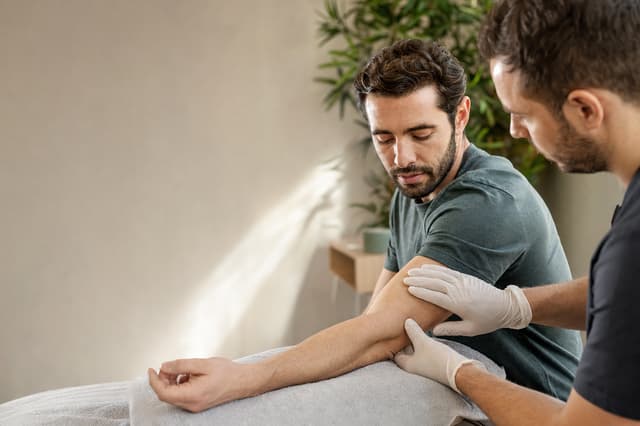
Tennis Elbow: Causes, Symptoms, and How Physiotherapy Treats It
Learn how tennis elbow treatment with physiotherapy can ease tendon load, improve strength, and support recovery from elbow pain in daily tasks at home.
9 min read
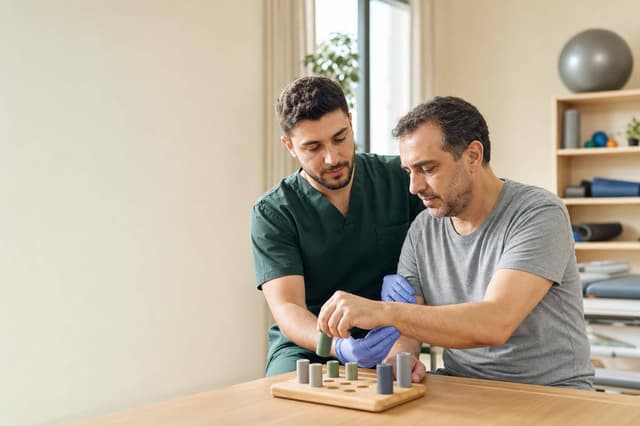
Stroke Rehabilitation: What Recovery Looks Like Month by Month
Learn how stroke rehabilitation can progress month by month, from early hospital care to outpatient therapy, with practical guidance for recovery needs.
4 min read

Shoulder Impingement vs Rotator Cuff Problems: Symptoms, Overlap and When Weakness Needs Assessment
Learn why impingement and rotator cuff symptoms overlap, what an assessment may check, and when new weakness after an injury needs prompt care.
6 min read