9 Questions to Ask Before Choosing a Physiotherapy Clinic in Dubai

Navigating healthcare options can feel overwhelming, especially when you are managing pain, stiffness, or a return-to-activity goal. This guide is for general education only and cannot diagnose your condition or replace an individual assessment from a qualified healthcare professional. If you are comparing options and wondering which questions to ask when choosing a physiotherapy clinic in Dubai, start with communication, consent, evidence, and your own preferences.
The short answer is: ask who will see you, how decisions are made, what options and risks will be explained, how consent is handled if the plan changes, and what information you will receive outside the session. A helpful doctor-led physiotherapy setting should make it easy to understand the role of each person involved in your care, the proposed plan, and your choices.
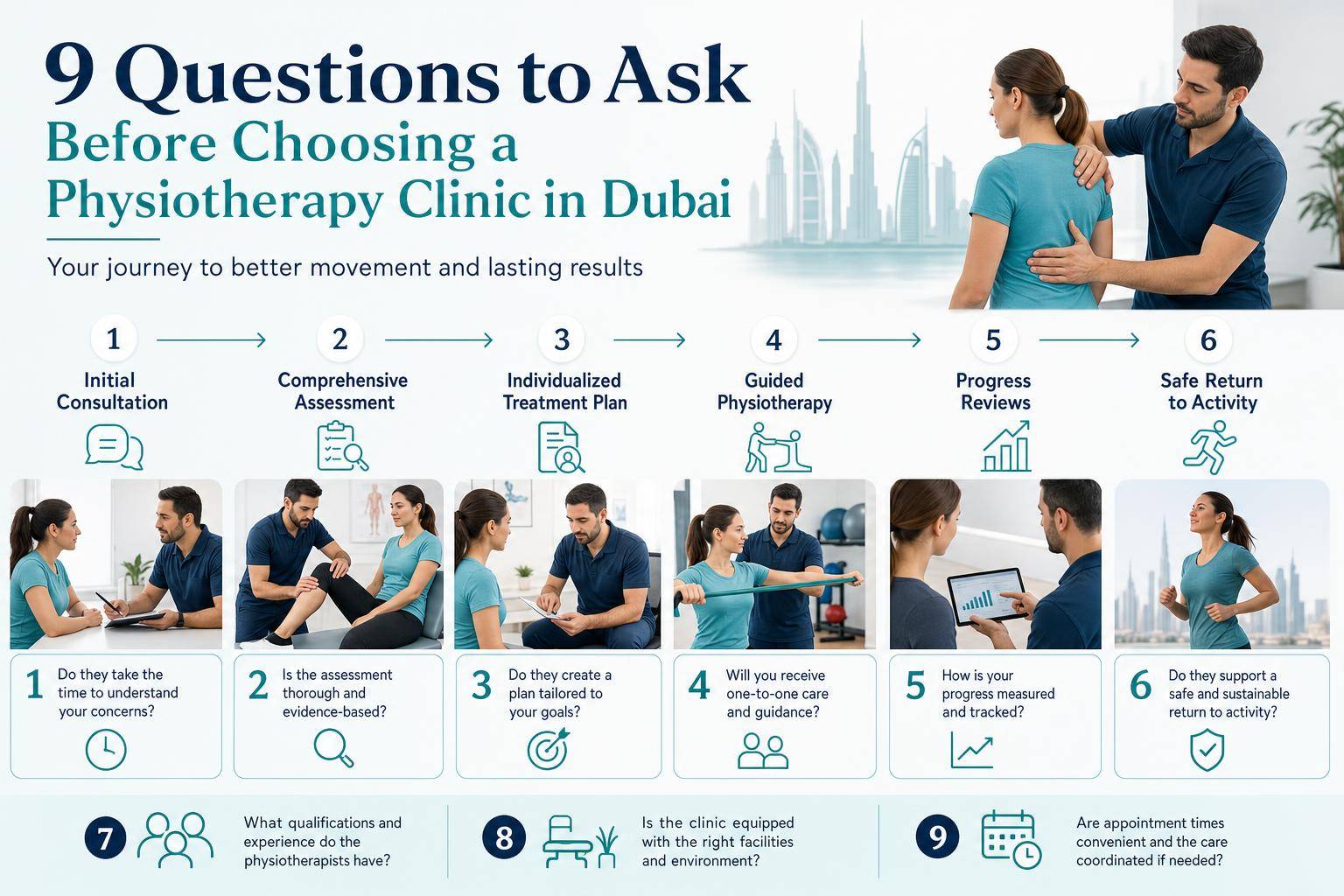
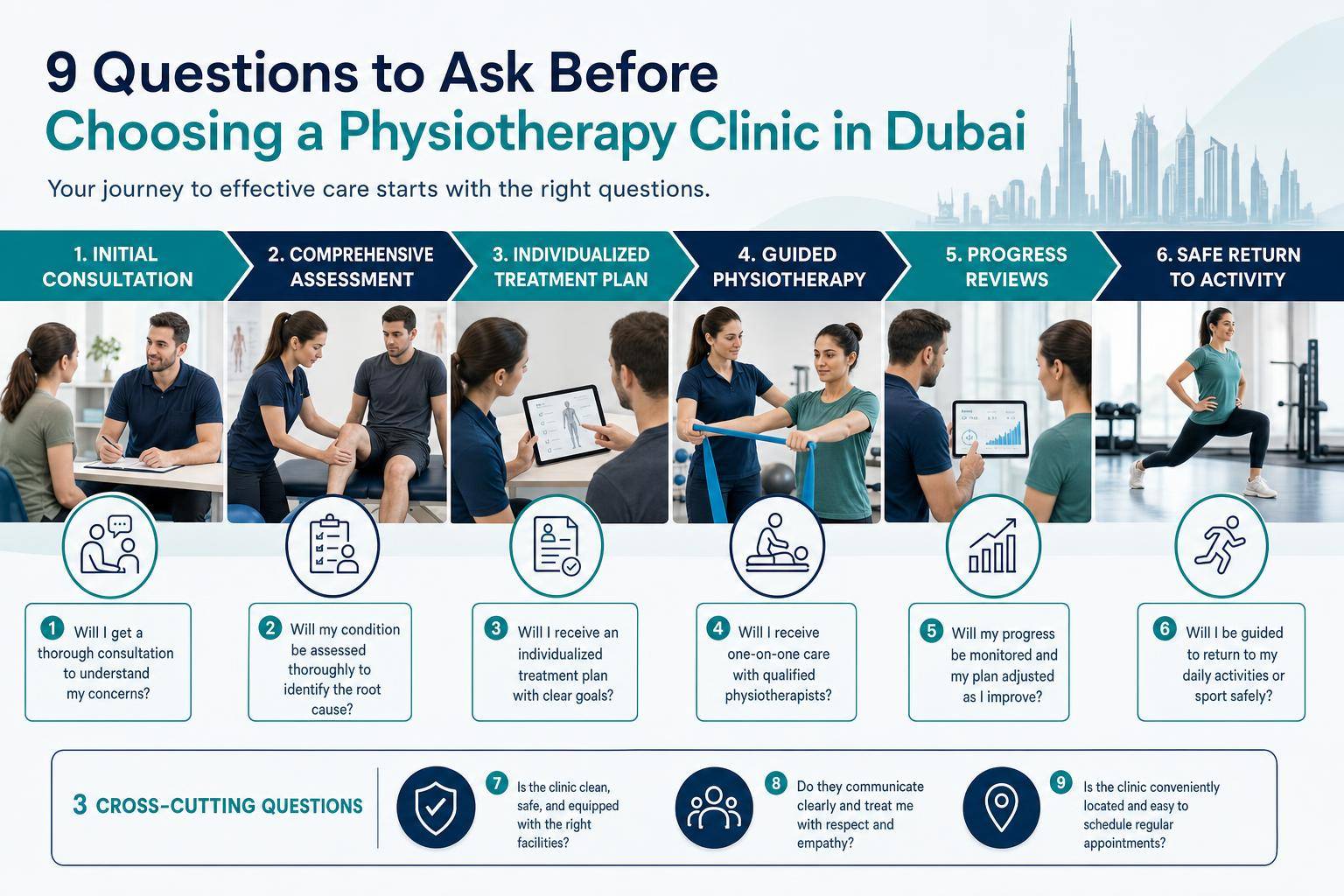
The 9 questions to ask before choosing a physiotherapy clinic
Use these nine questions as a practical conversation guide. They are not a legal checklist and they are not specific to one Dubai authority or one clinic type. They are based on verified consent and shared decision-making sources, including physiotherapy consent pathway material from Worcestershire Acute Hospitals NHS Trust, APTA’s Choosing Wisely page, and a peer-reviewed article on shared decision making in physical therapy.
1. Who will deliver each physiotherapy session?
Ask the clinic to identify the person who will assess or treat you and explain that person’s role. This is a practical question, not an accusation. The Worcestershire physiotherapy consent pathway states that the therapist or assistant performing the examination or treatment is responsible for ensuring the patient has consented to the intervention. It also notes that a qualified clinician remains accountable for the patient’s needs when some care is delegated to appropriately trained assistants.
You can ask: “Will I be seen by the same person each time?” “If an assistant is involved, what part of care will they provide?” and “Who is responsible for reviewing decisions about my plan?” If you want to look at a clinic’s staff background in advance, pages such as the clinical team overview or an individual profile such as Dr. Mina Gamil can help you prepare more focused questions.
2. How is my treatment plan created?
A plan should not feel mysterious. Shared decision making in physical therapy is described as a collaborative process in which patients and clinicians discuss available options, the benefits and harms of each option, and the patient’s values, preferences, and personal circumstances. In simple terms, you should be able to explain why a particular approach is being suggested and how it fits your life.
Helpful follow-up questions include: “What problem are we trying to solve first?” “Are there reasonable alternatives?” “What would happen if I chose to wait, modify activity, or try a different option?” Shared decision-making research describes key elements such as identifying the problem, explaining the health issue, discussing options, eliciting the patient’s preferences, and helping the patient weigh choices to reach an informed decision.
3. How will we review whether this plan is still the right choice?
The review question matters because treatment decisions may need to be revisited. The APTA Choosing Wisely page describes the campaign as promoting conversations between clinicians and patients to help patients choose care that is supported by evidence, not duplicative, free from harm, and truly necessary. It also states that care decisions should be based on the best available evidence, the clinician’s judgment, and the patient’s preferences and goals.

Ask how the clinic will talk with you if the expected benefit is not happening, if your priorities change, or if another option becomes more appropriate. The goal is not to demand a fixed guarantee of results. It is to understand how decisions will remain open, evidence-informed, and linked to what matters to you.
4. What information will you explain before starting treatment?
Consent is not just a signature. The Worcestershire pathway states that consent is a process and that a signed form does not prove valid consent; it records that appropriate discussions have taken place and records the patient’s decision. It also says patients need information necessary to make a reasoned decision, in a form they can understand.
Before you agree to treatment, ask the clinician to explain the proposed intervention, expected benefits, significant risks, side effects, and reasonable options. The same pathway states that informed consent includes discussion and understanding of treatment options, significant benefits, risks, side effects, material information, and the right to refuse treatment or examination. A peer-reviewed informed-consent study in physiotherapy also describes consent as connected to information disclosure, comprehension, and voluntariness.
5. How do you ensure ongoing consent and communication during treatment?
Physiotherapy can involve decisions during the session: changing position, trying a new technique, increasing or reducing intensity, or shifting the plan. The Worcestershire pathway states that changes to the treatment plan or modalities that have not previously been explained require further consent. Research on consent in treatment-focused bodywork also describes both early general consent and ongoing consent during care, especially when multiple therapies or in-the-moment decisions are involved.
You can ask, “Will you explain what you are doing before you do it?” and “Can I pause or decline a technique?” The consent pathway states that consent may be withdrawn at any time and that the patient’s attendance for an outpatient appointment does not indicate consent. That makes ongoing communication a core part of respectful care.
6. What are the potential risks, side effects, and alternatives for my situation?
This question helps make the discussion personal. The Worcestershire pathway highlights “material information,” meaning the effect of the treatment on that individual. A detail that is minor for one person may be important for another because of work, sport, family care, travel, or other commitments.
Ask the clinician to explain what benefits are expected, what significant risks or side effects are relevant, and whether there are alternatives. Shared decision making also includes balanced discussion of benefits, harms, and uncertainties. If the evidence for an option is limited or uncertain, the shared decision-making article notes that this uncertainty should be communicated to patients.
7. How do you involve me in shared decision-making about my care?
Shared decision making is more than being handed information. It means your clinician explains the health problem and options, while also asking about your goals, concerns, values, preferences, and personal circumstances. The peer-reviewed physical therapy article states that shared decision making can improve patient-clinician communication, improve the accuracy of expectations about intervention benefits and harms, increase involvement in decision-making, and help patients feel informed.

When choosing a physio clinic, listen for questions such as “What are you hoping to return to?” “What worries you about this option?” and “How much do you want to be involved in the decision?” The shared decision-making article also notes that patients should be invited to participate as much or as little as they desire.
8. How will consent, refusal, advice, and session details be documented?
Documentation supports continuity of conversation. The Worcestershire pathway states that refusal of examination or treatment should be documented with the reasons given. It also states that doubts about a patient’s understanding of risks and benefits should be recorded, and that the therapist should question the patient to establish understanding, with the result recorded in the notes. For assistant involvement, it states that assistants should write and sign treatment notes for patients they have seen alone, and that notes should include the therapist and assistant names when both are involved.
You do not need to turn this into a paperwork interrogation. A simple question is enough: “How do you record what we agreed, what I declined, and any changes to the plan?” This is especially useful if you are comparing different physiotherapy services or if more than one team member may be involved.
9. What information and support will you provide outside face-to-face sessions?
Many people leave a session with exercises, activity advice, or general information. Ask how the clinic makes that information understandable and relevant to you. The Worcestershire pathway recommends written guidance for class members and notes that general information or exercise sheets should contain a disclaimer that the information does not take into account every individual patient’s circumstances or conditions.
Good practical questions include: “Will I receive instructions I can follow at home?” “Are these exercises specific to me or general information?” and “What should I do if I am unsure what an instruction means?” If a clinic offers an initial consultation or introductory conversation, you can use it to ask how education, consent, and follow-up explanations are usually handled.
How to use these questions without feeling difficult
Patients sometimes worry that asking questions will seem challenging. In reality, the verified sources behind this guide emphasize conversation. APTA’s Choosing Wisely page describes recommendations as a way to spark thoughtful conversations between patients and caregivers, not to prohibit a treatment in every scenario or dictate care decisions. Shared decision-making research similarly frames the clinician and patient as bringing different forms of expertise: the clinician brings clinical knowledge, and the patient brings knowledge of their life, expectations, concerns, and preferences.
You can keep the discussion simple. Choose three questions that matter most to you before your first visit. For example, if you are anxious about hands-on treatment, focus on consent, risks, and your right to pause. If you are comparing locations in Dubai Silicon Oasis, focus on who will see you, how the plan is explained, and what information you will receive between visits. If you are searching for physiotherapy in Dubai for a long-running issue, focus on shared decision making and how alternatives will be discussed.
What a clear answer should sound like
A clear answer is specific, calm, and understandable. It names the person involved in care, explains the proposed option, acknowledges alternatives, discusses benefits and significant risks, and invites your preferences. It also leaves room for you to refuse, pause, or ask for more information. You should not need to understand medical jargon to participate in the decision.
For further reading on the principles behind these questions, see the Worcestershire Acute Hospitals NHS Trust physiotherapy consent pathway documents on consent for therapy services and capacity, benefits, risks, assistants, and written guidance, APTA’s Choosing Wisely page, and the peer-reviewed article Shared decision making and physical therapy: What, when, how, and why?
References
- PHYSIOTHERAPY PATHWAY WAHT-TP-011 Page 1 of 2 This information should be used in conjunction with the Physiotherapy Pathway WAHT-TP-011. Use the version on the internet to — apps.worcsacute.nhs.uk
- Choosing Wisely: The Right Care at the Right Time | APTA — www.apta.org
- PHYSIOTHERAPY PATHWAY WAHT-TP-011 Page 1 of 4 This information should be used in conjunction with the Physiotherapy Pathway WAHT-TP-011. Use the version on the internet to — apps.worcsacute.nhs.uk
- Negotiating Consent: Exploring Ethical Issues when Therapeutic Massage Bodywork Practitioners Are Trained in Multiple Therapies - PMC — pmc.ncbi.nlm.nih.gov
- Knowledge and practice of informed consent by physiotherapists and therapy assistants in KwaZulu-Natal Province, South Africa - PMC — pmc.ncbi.nlm.nih.gov
- Shared decision making and physical therapy: What, when, how, and why? - PMC — pmc.ncbi.nlm.nih.gov
- Informed Consent: What PTs Need To Know | APTA — www.apta.org
Related care at Physio Cure Dubai
Doctor-led services for what you have just read about.
Frequently Asked Questions
What are the 9 questions to ask before choosing a physiotherapy clinic?
Ask: 1) Who will deliver each session? 2) How is my plan created? 3) How will we review the plan? 4) What is explained before treatment? 5) How is ongoing consent handled? 6) What are risks and alternatives? 7) How am I involved in decisions? 8) How are decisions documented? 9) What support is provided outside sessions?
Who should explain and confirm consent before treatment?
The person performing the examination or treatment should check that you have consented. If an assistant is involved, ask what they will do and who remains responsible for your overall care decisions.
What information should be explained before physiotherapy treatment?
You should be told the proposed treatment, expected benefits, significant risks, side effects, relevant alternatives, and your right to refuse. The explanation should be in language you can understand.
Is consent just a form I sign at the clinic?
No. Consent is described in the verified sources as a process. A signed form may record a discussion, but valid consent depends on understanding, voluntariness, and enough information to decide.
What if the physiotherapy plan changes during care?
If a new technique, modality, or plan change has not already been explained, further consent should be obtained. You can ask the clinician to pause and explain before continuing.
How does shared decision making apply to physiotherapy?
Shared decision making means you and the clinician discuss the problem, available options, benefits and harms, uncertainties, and your values and preferences before reaching an informed choice.
Should I ask about documentation during physiotherapy?
Yes. You can ask how the clinic records what was explained, what you agreed to, any refusal, and any changes to the plan. Documentation helps keep decisions clear over time.
Are these questions specific legal requirements for Dubai clinics?
No. This guide does not provide Dubai-specific legal or regulatory advice. The questions are practical prompts based on verified consent and shared decision-making sources.
Related Articles

Achilles Tendinitis Recovery: Key Milestones for Runners
Learn achilles tendinitis recovery milestones for runners, from walking pain limits to heel raises, walk-run progressions, and safe training load changes.
8 min read

Physiotherapy and Insurance in Dubai: 7 Things to Know About Reimbursement, Referrals, and Documentation
Learn how physiotherapy insurance reimbursement works in dubai, including referrals, pre-authorization, documents, limits, and claim steps for patients.
8 min read

Shockwave Therapy: What Happens Before, During and After?
Learn what happens during a shockwave therapy session, from assessment and gel application to tapping sensations, aftercare, and when to seek advice.
5 min read