Whiplash After a Car Accident: When to Seek Medical Assessment

After a car accident, neck pain and stiffness may not be obvious straight away. Whiplash is a neck injury caused by sudden movement of the head, often from a traffic accident, slip, fall, or sports injury. It is also called a neck sprain or strain. Most people improve, but the timing and severity of symptoms can vary, so it helps to know when whiplash symptoms after a car accident need assessment and what to expect if you are checked by a clinician.
This guide is for general education. It cannot diagnose your injury or replace advice from a qualified healthcare professional. If you have neck pain or other whiplash symptoms after a car accident, sports injury, or other injury, the Mayo Clinic advises seeing a healthcare professional to help rule out broken bones or other damage that could cause or worsen symptoms.
Quick answer: when to seek assessment
1. Check for red flag symptoms
Seek urgent medical help if you have injured your neck and develop severe pain despite simple painkillers, tingling or pins and needles on one or both sides of the body, weakness in the hands, arms, or legs, problems walking or sitting upright, difficulty coordinating movement, a sudden “electric shock” feeling in the neck and back that may travel into the arms or legs, or sudden or worsening severe headaches. These symptoms are listed in NHS and Berkshire Healthcare advice as signs that need urgent help because they could be related to nerve or spinal cord involvement.
2. Arrange a non-urgent review if symptoms are not improving
If symptoms have not improved after one week, painkillers such as paracetamol or ibuprofen have not helped, or you are worried about the pain, the NHS whiplash guidance recommends seeing a GP. Some patient leaflets also advise speaking with a GP if you are not returning to normal activities as expected or if symptoms continue beyond the early recovery period.
3. Expect that symptoms can be delayed
Whiplash symptoms can take several hours to appear and may develop over a few days. Royal Berkshire NHS guidance notes that inflammation and bruising in the neck muscles are not usually obvious at the time of the accident, and pain and stiffness are often worse the next day.
4. Keep gently active if it is safe for you
For straightforward whiplash symptoms, trusted sources advise trying to continue everyday activities and avoiding long periods of rest. This may hurt a little, but normal activity can help recovery. If pain is severe, some guidance says resting the neck briefly for a day or so may be needed before gently increasing movement.
5. Ask questions before agreeing to examination or treatment
If you are offered an examination, treatment, or investigation, it is reasonable to ask what it is for, what alternatives are available, and what risks and benefits apply to your situation. Hull University Teaching Hospitals’ patient information explains that consent should be based on enough information and that you should ask more questions if you do not understand or want more detail.
Understanding whiplash and delayed symptoms
Whiplash happens when the head is suddenly forced forwards, backwards, or sideways, stretching the soft tissues of the neck. It is common after road traffic accidents, but it can also happen after a fall, sports injury, or a blow to the head. During this movement, muscles, ligaments, and tendons can be overstretched, leading to pain, stiffness, reduced movement, and muscle spasm.
The delay in symptoms is one reason whiplash can feel confusing. NHS guidance says symptoms can take several hours to start after a neck injury. Royal Berkshire NHS guidance gives a more specific estimate that symptoms may take 6 to 12 hours to become apparent, and that pain and stiffness may continue to worsen during the days after injury. A delay does not automatically mean there is a serious injury, but it is a reason to monitor symptoms carefully.
What happens in the neck during whiplash?
The neck is strong and flexible. It is made of vertebrae, discs, ligaments, and muscles that help support and protect the head and spine. In a whiplash-type injury, the sudden movement can stretch soft tissues beyond their usual range. Royal Berkshire NHS guidance describes whiplash as damage to the ligaments and tendons in the neck, even though tests and scans are not usually required to diagnose typical whiplash.
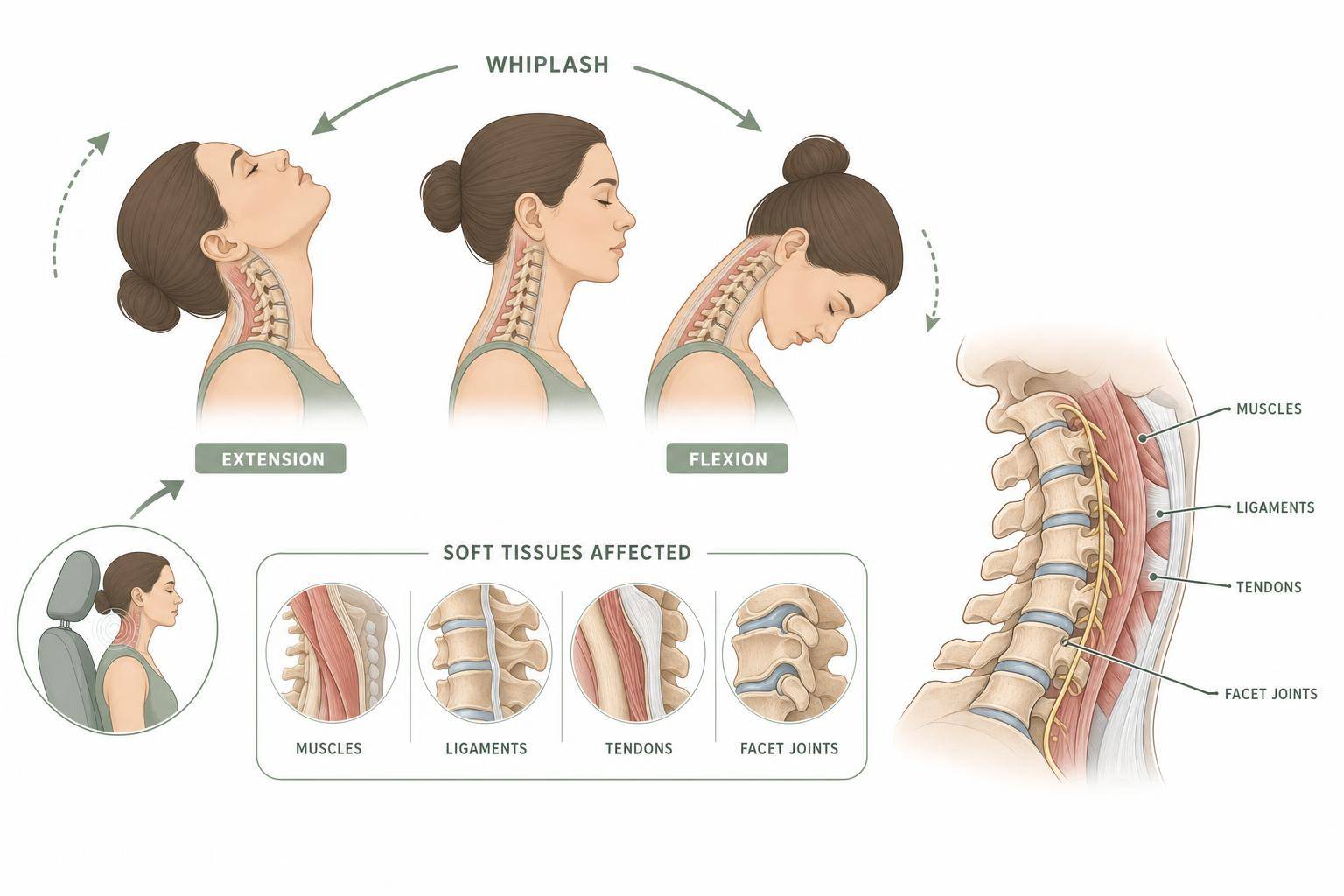
Symptoms often include neck pain, stiffness, difficulty moving the head, headaches, shoulder or arm discomfort, and muscle spasms. Some people also report tiredness, difficulty concentrating, dizziness, blurred vision, ringing in the ears, trouble sleeping, or tingling and numbness in the arms. Berkshire Healthcare notes that many symptoms are temporary and improve with simple self-care, while Mayo Clinic notes that some people can have longer-lasting neck pain.
Red flags versus routine review
It can help to separate urgent symptoms from symptoms that need planned follow-up. Urgent symptoms include neurological-type changes such as weakness, loss of feeling, pins and needles on one or both sides of the body, difficulty walking, difficulty coordinating movement, or an electric shock sensation in the neck and back. Severe or worsening symptoms that do not respond to simple measures also need urgent medical help according to Berkshire Healthcare advice.
For non-urgent symptoms, a GP can help if symptoms are not getting better after one week, simple painkillers have not worked, or you are worried about the pain. NHS guidance also says check-ups every few weeks may be used for whiplash, and if symptoms do not get better a GP may refer to a physiotherapist, pain specialist, or psychological support.
What happens during a clinical assessment?
During a whiplash assessment, your healthcare professional will usually ask about the event, your symptoms, how severe they are, how often they occur, and how well you can do everyday tasks. They may ask when symptoms started, whether movement makes pain worse, whether you have had neck pain before, and what medicines or other treatments you have tried.
On examination, Mayo Clinic guidance says a healthcare professional may need to touch and move your head, neck, and arms. You may be asked to do simple movements so they can check neck and shoulder range of motion, the degree of movement that causes or increases pain, tenderness in the neck, shoulders, or back, and reflexes, strength, and feeling in the limbs.
Imaging is not always needed. A whiplash injury itself does not show on imaging tests, but scans may help rule out other conditions. X-rays can show broken bones, arthritis, or other issues; CT can provide detailed bone images; and MRI can show some soft tissue injuries such as damage to the spinal cord, discs, or ligaments. Royal Berkshire NHS guidance also states that tests and scans are not usually required to diagnose whiplash, but may be recommended if another problem such as a spinal injury is suspected.
Early self-care: movement, comfort, and medicines
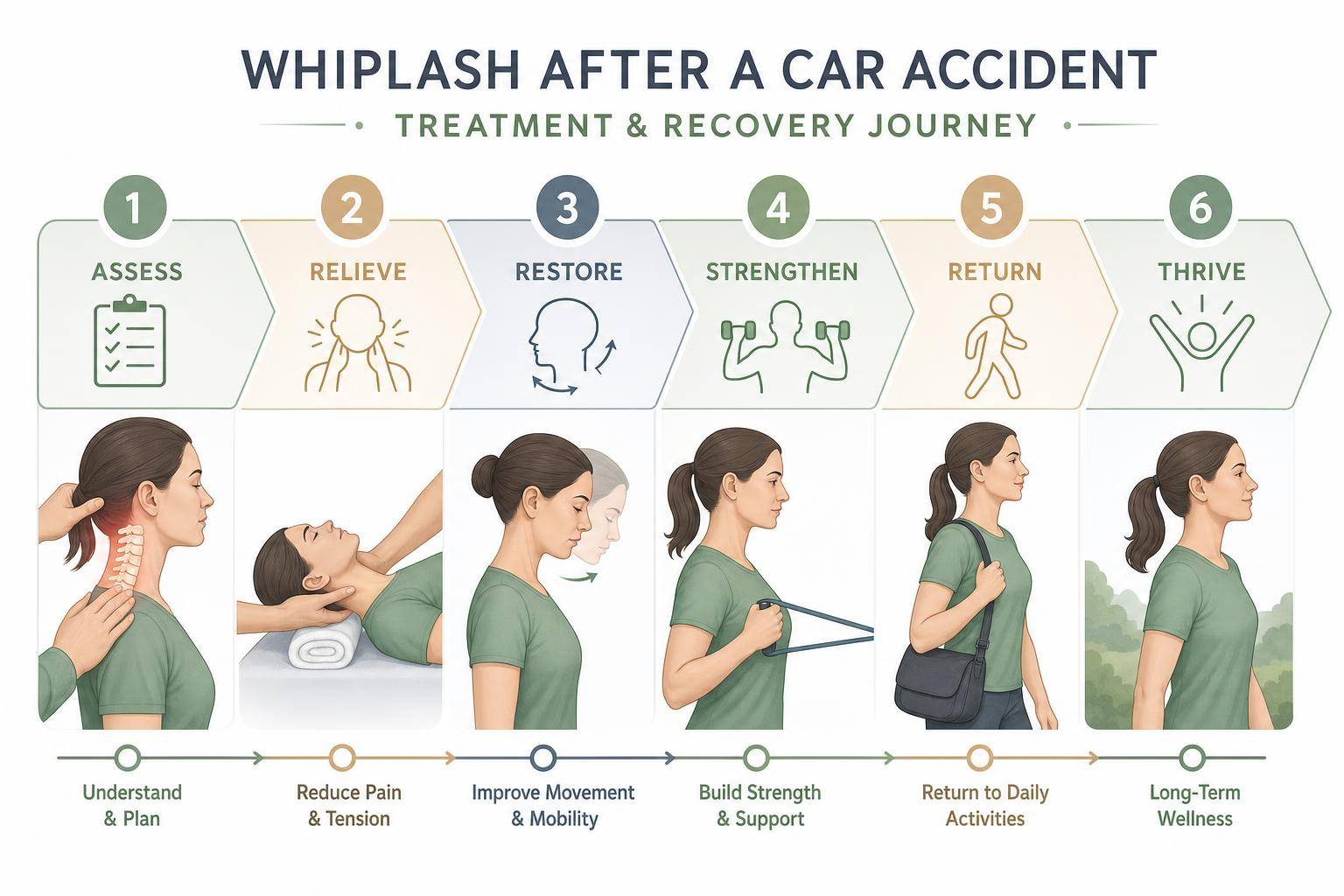
The treatment goals described by Mayo Clinic are to control pain, restore range of motion in the neck, and help you return to regular activities. For many people, early self-care includes gentle activity, short-term pain relief when suitable, and heat or cold for comfort.

Try to continue everyday activities if you can do so safely. NHS advice says continuing everyday activities may hurt a little but can speed recovery, and that using a neck brace or collar does not help for routine whiplash. Mayo Clinic notes that rest may help for a day or two after injury, but too much bed rest may slow healing. If driving, Berkshire Healthcare advises returning only when you can turn your head to look over both shoulders comfortably and safely and can control the vehicle without hesitation.
Painkillers may help reduce discomfort so you can stay active. NHS guidance lists paracetamol or ibuprofen for pain. Royal Berkshire NHS guidance explains that paracetamol can help ease pain, while non-steroidal anti-inflammatory drugs such as ibuprofen may help reduce inflammation. Always follow the medicine leaflet and do not exceed the recommended dose. NSAIDs such as ibuprofen may not be suitable for everyone, including some people with asthma, high blood pressure, kidney failure, heart failure, or people taking other medicines, so checking with a GP or pharmacist can help you choose a suitable option.
Exercises and physiotherapy
Gentle exercises may help reduce stiffness and support recovery when they are suitable for your symptoms. Berkshire Healthcare advises completing gentle exercises little and often; they may be uncomfortable, but they should not significantly increase symptoms. If exercises make symptoms worse, take a break or do them less frequently and through a smaller range, and speak to a GP if you need more help.

Common movements listed in patient guidance include rotating the neck to each side, tilting the head side to side, bending the neck toward the chest, rolling the shoulders, and gentle upper-body stretching. Keep the movements slow and comfortable. Avoid forcing through sharp pain, and seek medical advice first if you have red flag symptoms or are unsure whether exercise is appropriate.
Physical therapy may be considered if whiplash pain is ongoing or if you need help with range-of-motion exercises. Mayo Clinic states that physical therapy might help people with ongoing whiplash pain feel better and prevent further injury, with a therapist guiding exercises to strengthen muscles, improve posture, and restore movement. NHS guidance also notes that if symptoms do not get better, a GP may refer to a physiotherapist or pain specialist.
For readers comparing care options, Physio Cure Dubai has related information pages on neck pain treatment, manual therapy, neurological physiotherapy, and back pain treatment. You can also read about Dr. Nada Mohammad. These links are provided as related site navigation rather than a substitute for an individual assessment.
Recovery outlook after whiplash
Recovery varies. NHS guidance says whiplash usually gets better within 2 to 3 months, although some people have symptoms for longer. Royal Berkshire NHS guidance states that in about 60% of cases, symptoms improve significantly or completely disappear within one to four weeks, while some people take a few months and some have longer-lasting pain and stiffness.
Mayo Clinic notes that recovery can be harder to predict when first symptoms are intense, start quickly, and include severe neck pain, more-limited range of motion, or pain spreading to the arms. Linked factors for a worse outcome include having had whiplash before, older age, already having low back or neck pain, and a high-speed injury.
Stress and anxiety after a motor vehicle accident can also influence how much discomfort you feel. Oxford University Hospitals guidance notes that tense muscles caused by anxiety and stress can increase discomfort, and that exercise, controlled breathing, and relaxation may be helpful. Berkshire Healthcare similarly lists mindfulness, breathing apps, gentle walking, or calming music as options that may help reduce muscle tension and improve pain.
The safest overall approach is to monitor symptoms, keep gently active when appropriate, use medicines only as directed and when suitable for you, and seek assessment if symptoms are severe, worsening, not improving, or worrying. Whiplash is often temporary, but careful follow-up helps ensure that symptoms needing a different level of care are not missed.
References
- Whiplash - NHS — www.nhs.uk
- PowerPoint Presentation — www.berkshirehealthcare.nhs.uk
- Physiotherapy advice for whiplash | Berkshire Healthcare NHS Foundation Trust — www.berkshirehealthcare.nhs.uk
- Neck Sprain (Whiplash type injury) — www.ouh.nhs.uk
- Neck injury (whiplash / neck sprain), December 2025 1 Neck injury (whiplash / neck sprain) You have been diagnosed in the Emergency Department with a neck injury (whiplash). T — www.royalberkshire.nhs.uk
- Whiplash - Symptoms and causes - Mayo Clinic — www.mayoclinic.org
- Neck Pain | Hull University Teaching Hospitals NHS Trust — www.hey.nhs.uk
- Whiplash - Diagnosis and treatment - Mayo Clinic — www.mayoclinic.org
Related care at Physio Cure Dubai
Doctor-led services for what you have just read about.
Frequently Asked Questions
Can whiplash symptoms be delayed?
Yes. Whiplash symptoms can take several hours to start and may develop over a few days. Pain and stiffness are often worse the day after the injury.
Which whiplash symptoms need urgent medical help?
Seek urgent help for severe pain despite simple painkillers, weakness, loss of feeling, pins and needles on one or both sides, walking or coordination problems, trouble sitting upright, an electric shock feeling in the neck or back, or sudden worsening severe headaches.
When should I see a doctor if symptoms are not urgent?
See a GP or healthcare professional if symptoms have not improved after one week, painkillers have not helped, or you are worried about the pain.
What happens during a whiplash assessment?
A clinician will usually ask how the injury happened, when symptoms started, how severe they are, and how daily tasks are affected. They may check neck and shoulder movement, tenderness, reflexes, strength, and sensation.
Do I need an X-ray, CT, or MRI for whiplash?
Not always. Whiplash itself does not show on imaging, and scans are not usually required for typical whiplash. Imaging may be used to rule out broken bones, spinal injury, or other issues when suspected.
How should I manage whiplash in the first few days?
Try to continue everyday activities as safely as you can, avoid long periods of neck rest, and use heat or cold for comfort. Painkillers may help, but follow the leaflet and ask a GP or pharmacist if you are unsure what is suitable.
Can physiotherapy help after whiplash?
Physiotherapy may help if whiplash pain is ongoing or you need help with range-of-motion exercises. A physiotherapist can guide exercises to strengthen muscles, improve posture, and restore movement.
How long does whiplash recovery usually take?
Many people improve within weeks, and whiplash usually gets better within 2 to 3 months. Some people have symptoms for longer, especially when initial symptoms are severe or other risk factors are present.
Related Articles

9 Questions to Ask Before Choosing a Physiotherapy Clinic in Dubai
Nine practical questions to ask before choosing a physiotherapy clinic in Dubai, covering consent, shared decisions, roles, risks, and support.
7 min read

Stretches to Relieve Postural Back Pain Quickly & Safely
Get 7 physiotherapist-approved stretches to release tight hips, fix slouching, and ease postural back pain. Try this daily routine for lasting relief.
16 min read

Slouch No More with Expert Spinal Posture Correction
Discover how doctor-led spinal adjustments, holistic physiotherapy, and tailored exercise reverse slouching, ease neck & back pain, and rebuild healthy posture.
15 min read