Achilles Tendinitis Recovery: Key Milestones for Runners
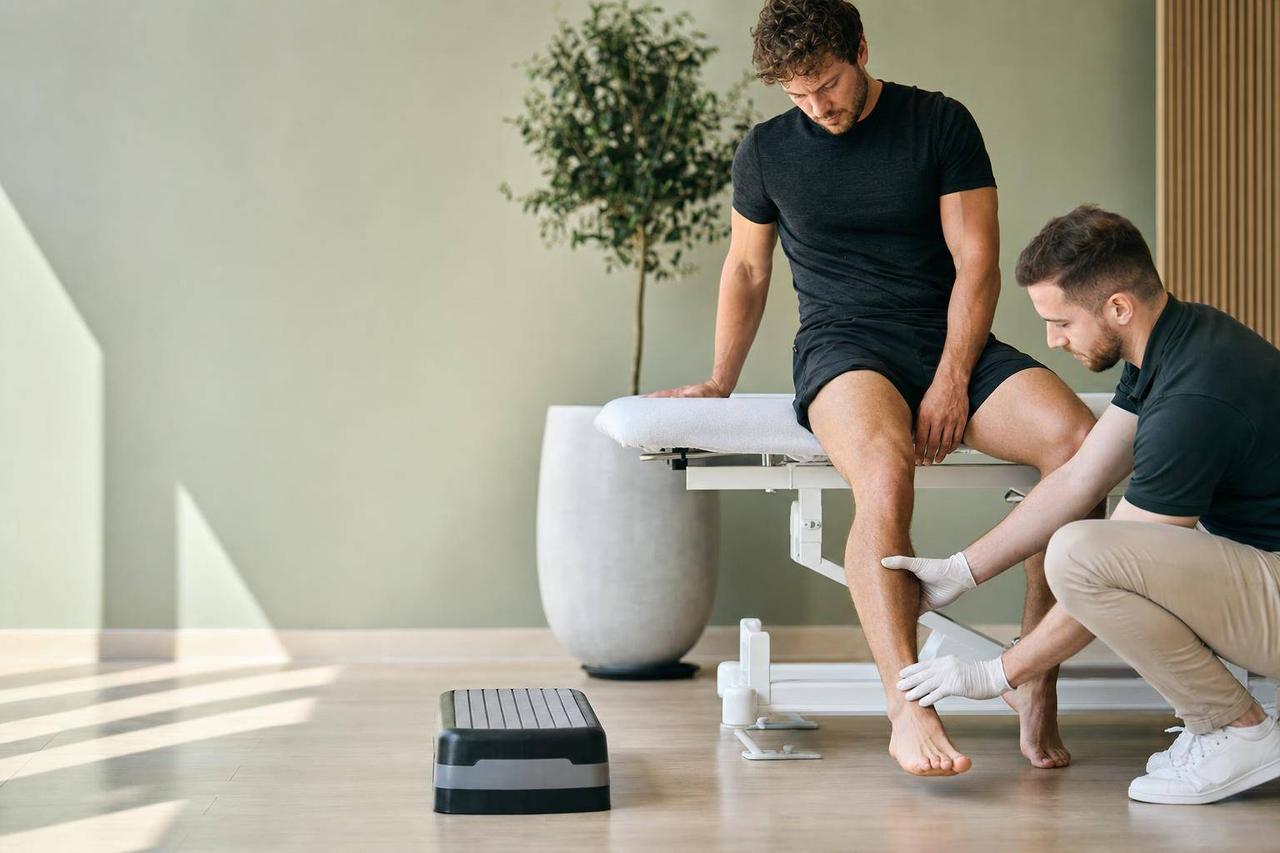
When you are sidelined by heel and calf pain, the biggest question is usually how soon you can get back to your normal training routine. Navigating achilles tendinitis recovery milestones for runners requires patience, structured loading, and careful monitoring of your symptoms. Rather than waiting for an arbitrary number of weeks to pass, a successful return to the road or trail is built on meeting specific physical benchmarks. Please remember that online health information cannot diagnose your condition, prescribe an individual treatment plan, or replace a professional clinical assessment. Recovery timelines vary widely from several weeks to many months depending on your specific situation, and there are no quick fixes or permanent cures. Instead, rehabilitation focuses on gradually restoring your tendon capacity.
Why the Achilles flares up
Runners often experience tendon issues when the load applied to the tissue exceeds its current capacity to adapt and recover. This is not necessarily about running with bad form; it is usually about training variables changing too quickly. A sudden spike in weekly mileage, introducing hill repeats before you are ready, switching to a lower-drop running shoe, or taking time off and returning at your previous volume can all overload the Achilles tendon. The tendon responds to this excess load by becoming irritated and painful. Understanding this concept is the first step in rehabilitation because it shifts the focus away from simply resting. Complete rest might calm the initial pain, but it does not build the strength your tendon needs to handle the impact of running again. To bridge that gap, you need a progressive loading strategy.
Understanding your condition: Midportion versus Insertional
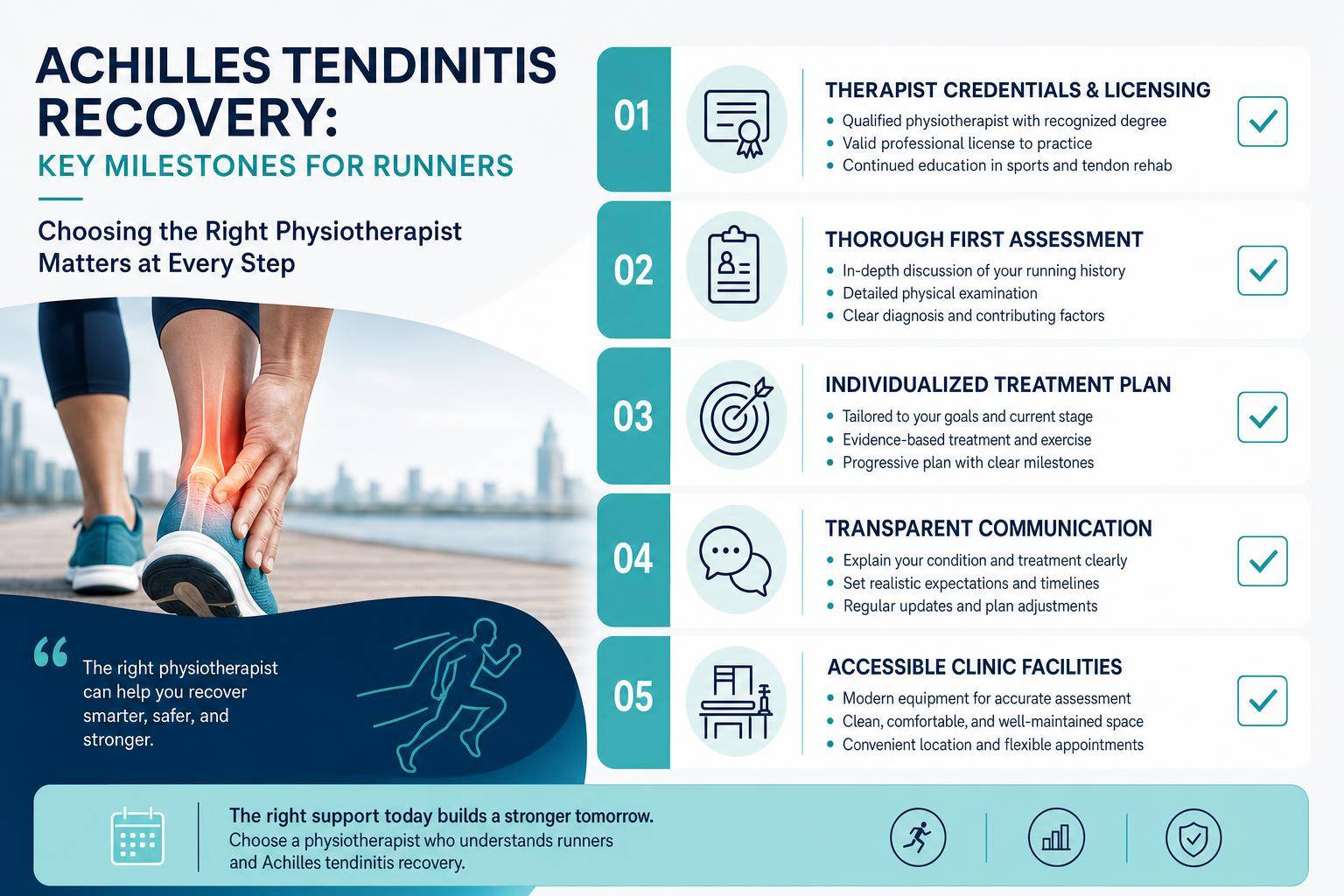
Before discussing specific criteria, it helps to understand that Achilles tendinopathy generally falls into two distinct categories based on where the pain is located. Midportion Achilles tendinopathy affects the thickest part of the tendon, usually a few centimeters above the heel bone. This is the most common type among runners. Insertional Achilles tendinopathy occurs lower down, exactly where the tendon attaches to the heel bone. The location matters because it dictates how you might modify your exercises early in rehab. For example, the insertional tendon is highly sensitive to compression. Research suggests that if you have insertional pain, you may need to avoid stretching the calf deeply over the edge of a step, as this increases compression against the heel bone. Instead, flat-ground exercises are often better tolerated in the beginning. Identifying which type you are managing is a key part of your initial physiotherapy assessment.
The key exercise: heel drops and heavy resistance
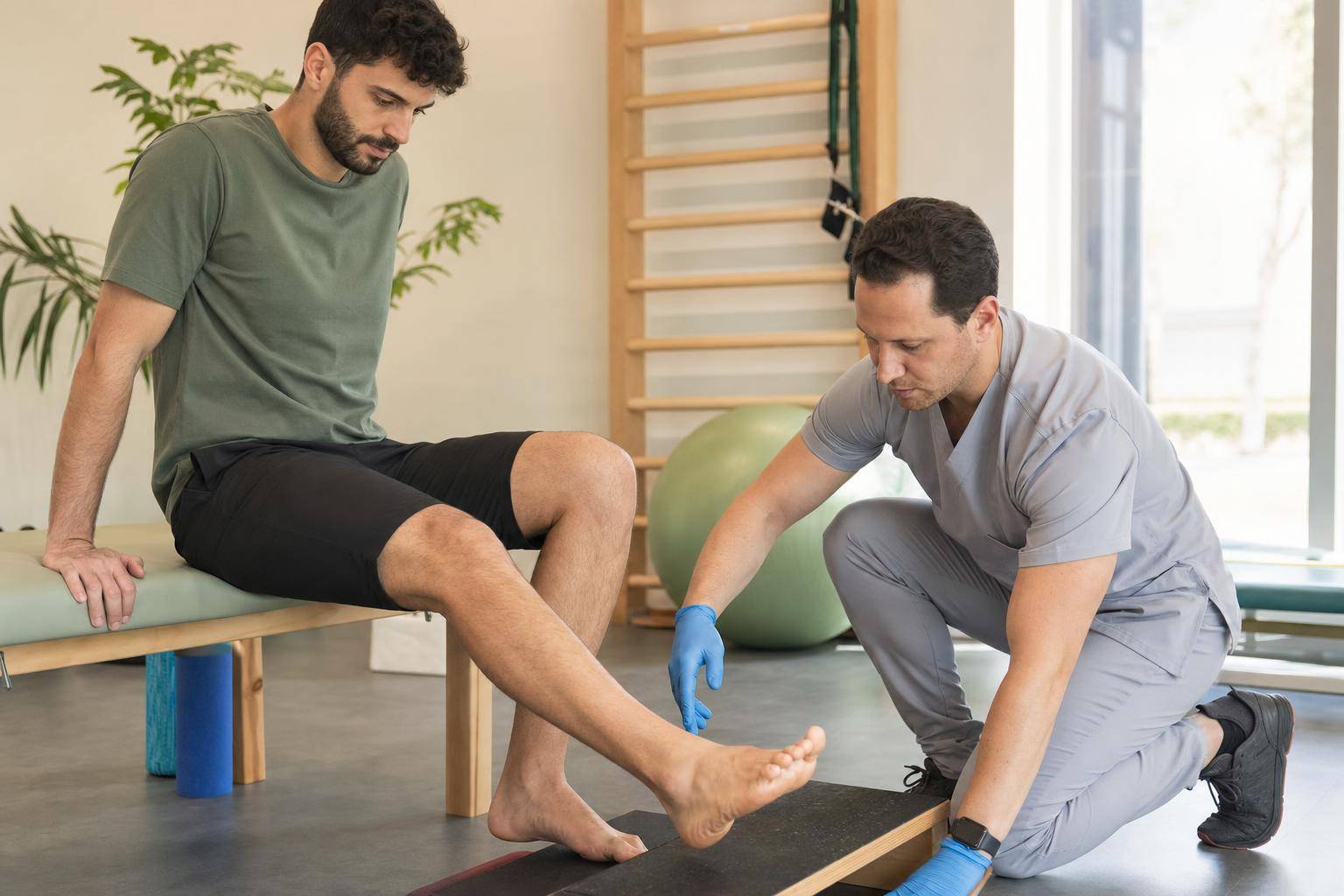
Building tendon capacity requires specific types of strength training, most notably heavy slow resistance and eccentric exercises. You may have heard of heel drops, where you rise up on both toes and slowly lower yourself down on the painful leg. While eccentric exercises are incredibly valuable, modern rehabilitation also emphasizes heavy slow resistance training to build overall strength in the calf muscle complex. This often involves performing calf raises with added weight at a slow, controlled tempo. Maintaining heavy calf strengthening two to three times per week as running progresses is a crucial part of the process, rather than something you only do before returning to sport. Medical Director Dr. Mina Gamil, whose expertise includes orthopedic rehabilitation and sports rehabilitation, often emphasizes that building capacity through targeted strength training forms the foundation of recovery. Building this foundational strength prepares the tissue for the high-impact demands of running.
Getting back to running

Returning to running is not a single event; it is a carefully graded process. The transition from walking to full running should be guided by specific functional criteria rather than a calendar. Many runners try to test their tendon by going for a short run too early, only to experience a flare-up that sets them back. By following evidence-based milestones, you can measure your readiness objectively. These benchmarks help you understand when it is safe to start, how much discomfort is acceptable, and when you are ready to increase your speed and distance.
Achilles Tendinitis Recovery Milestones
Different clinical protocols use overlapping criteria involving pain limits, functional tests, strength measures, and workload progression rather than a single fixed checklist. However, the following milestones represent the general consensus in sports rehabilitation for safely returning to running.
1. Minimal pain with daily walking
Before any running, jumping, or high-impact activities are introduced, your symptoms during everyday tasks must be under control. Research indicates that pain during daily walking should be minimal, generally rating no higher than a 1 or 2 on a 0 to 10 pain scale. You should be able to walk without limping, and routine activities like climbing stairs or walking around the house should not cause your tendon to ache excessively. Furthermore, you should not experience any swelling or a flare-up of pain the day after normal daily walking. If basic walking still causes noticeable pain, the tendon is not yet ready for the repetitive impact of running.
2. Mastering single-leg heel raises
Calf strength is a non-negotiable prerequisite for running. Multiple sports medicine protocols use the single-leg heel raise as a primary readiness marker. A common benchmark is the ability to complete 3 sets of 15 single-leg heel raises through a full range of motion with little or no pain. Some detailed clinic protocols are even more rigorous, looking for 25 heel raises performed at a steady pace of 30 beats per minute, alongside loaded calf exercises using a percentage of your body weight. If you cannot lift your own body weight repeatedly on one leg, your calf and Achilles will struggle to absorb the forces of running, which can be several times your body weight with every step.
3. Following the 24-hour symptom rule
One of the most important milestones is learning how to interpret pain. Completely pain-free rehabilitation is rare, and mild discomfort is generally acceptable. Evidence-based running guidance suggests that pain during and immediately after a run should stay at or below a 3 out of 10. More importantly, you must monitor how the tendon responds over the next 24 hours. Any mild pain should settle within a day, and you should not experience a significant increase in morning stiffness the following day. If your pain spikes above a 3, or if you wake up the next morning with severe stiffness and soreness that lingers, that is a clear signal that the previous day's load was too high and you need an extra rest day or a reduction in your next session.
4. Surviving the walk-run progression
When you finally meet the criteria to run, you do not simply resume your old route. A structured walk-run progression is essential. Several runner-specific protocols recommend starting with interval training on flat, forgiving surfaces every other day. A typical starting point might be a 20 to 30-minute session alternating 1 to 2 minutes of easy running with 2 to 4 minutes of walking. During this phase, total running volume is usually kept to around 40 percent of your pre-injury distance. This interval approach allows you to expose the tendon to running loads in small, manageable doses while applying the 24-hour symptom rule to ensure you are not overdoing it.
5. Progressing volume, then frequency, then intensity
Once you tolerate the walk-run intervals, the order in which you add variables matters greatly. Runner-oriented protocols advise increasing your workload systematically. First, you increase the duration of your easy running intervals until you can run continuously for a reasonable time. Next, you increase the frequency of your runs, eventually running on consecutive days if your training requires it. Only after volume and frequency are established should you add intensity, such as speed work or tempo runs. Hills and plyometrics are introduced last. Workload recommendations generally advise keeping weekly volume increases to about 10 to 15 percent to avoid acute spikes in training load that could trigger a relapse.
6. Hitting high-level strength and plyometric benchmarks
The final milestone involves ensuring your leg is strong and powerful enough to handle full training and eventually racing. For high-demand sports, rehabilitation literature often targets an isometric seated calf strength of 1.5 to 2.0 times your body weight. You should also be able to perform repeated single-leg hops and plyometric drills symmetrically, with the injured leg performing at least 90 percent as well as the uninjured leg. Passing these functional tests without compensatory mechanics or next-day flare-ups gives you the confidence that your tendon can handle the rigorous demands of unrestricted running.
Physiotherapy treatments and recovery support
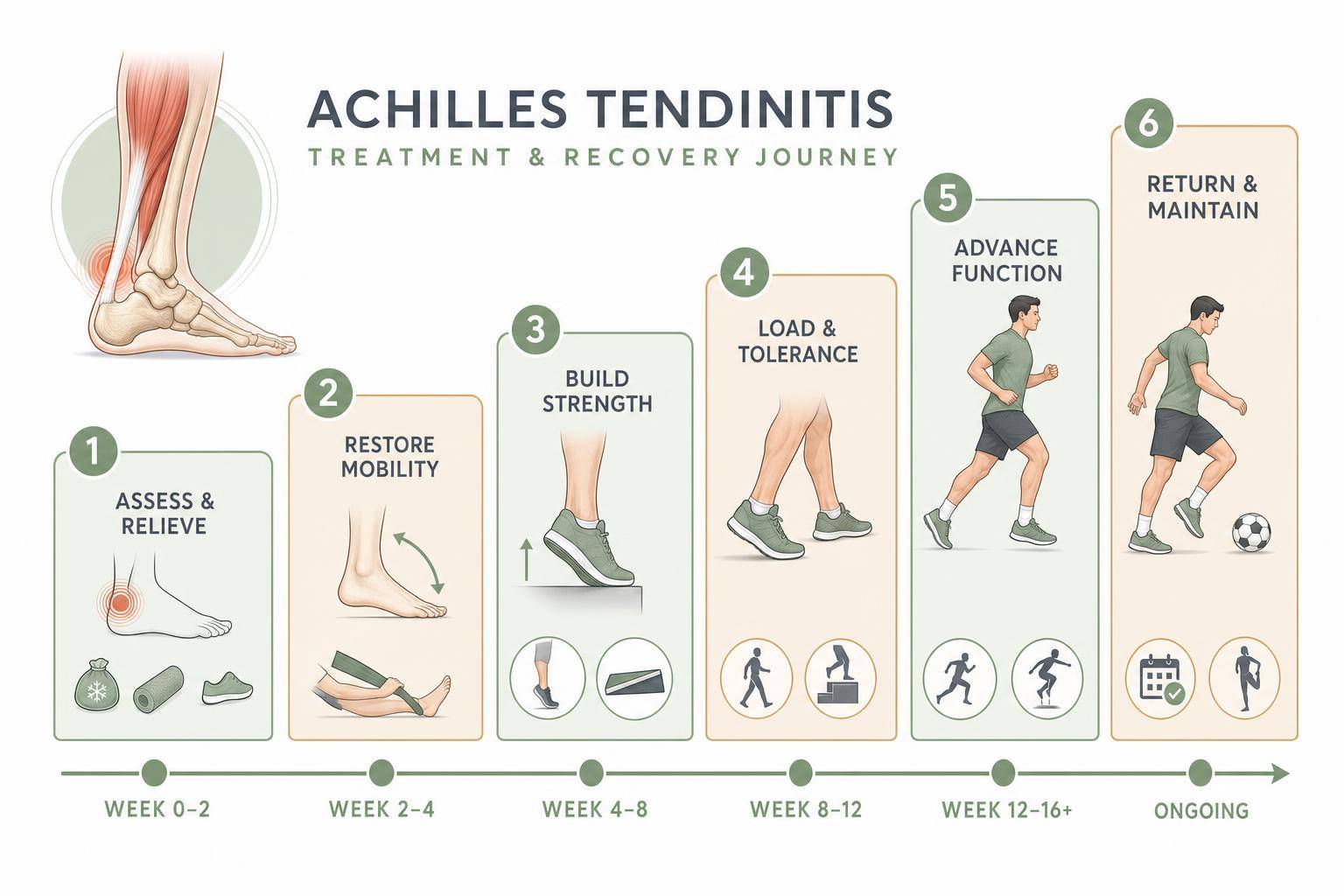
Reaching these milestones safely is much easier with professional guidance. A thorough clinical assessment will determine exactly where your deficits lie and which phase of recovery you are currently in. Seeking targeted Achilles tendinitis treatment ensures that your exercise program is tailored to your specific presentation, whether midportion or insertional. A structured sports injury rehabilitation plan will guide you through the heavy slow resistance training, plyometric testing, and the walk-run progressions safely.
Alongside active exercise, some patients may benefit from passive modalities as part of an assessment-led care plan. When supported by clinical findings, your physiotherapist might suggest shockwave therapy to help stimulate tissue response, or manual therapy to address joint mobility and muscle tightness in the surrounding areas of the foot, ankle, and calf. While these modalities are not standalone fixes, they can serve as helpful adjuncts to reduce symptom severity and make your strengthening exercises more tolerable. The ultimate goal is always to restore the functional capacity of your tendon so you can return to the roads with confidence and resilience.
Related care at Physio Cure Dubai
Doctor-led services for what you have just read about.
Frequently Asked Questions
What causes Achilles tendinitis to flare up in runners?
Achilles pain often flares when the load on the tendon rises faster than it can adapt. Common triggers include a sudden mileage increase, hill repeats, changing to a lower-drop shoe, or returning to previous training volume after time off. Rest may calm symptoms, but progressive loading is usually needed to rebuild tendon capacity.
How do I know whether my Achilles pain is midportion or insertional?
Midportion Achilles tendinopathy usually causes pain a few centimeters above the heel bone. Insertional Achilles tendinopathy is felt lower down where the tendon attaches to the heel. This distinction matters because insertional pain may be aggravated by deep calf stretching over a step, so a physiotherapy assessment can help guide the right exercise modifications.
What are the key Achilles tendinitis recovery milestones before running again?
Before running, you should have minimal pain with daily walking, no limp, and no next-day swelling or flare-up. A common strength marker is completing 3 sets of 15 single-leg heel raises with full range and little or no pain. From there, a graded walk-run program can help test how the tendon responds to impact.
Is it okay to run with mild Achilles tendinitis discomfort?
Mild discomfort can be acceptable during rehab if it stays at or below about 3 out of 10 and settles within 24 hours. You should not run through sharp, escalating pain, a limp, or stiffness that is clearly worse the next morning. If symptoms linger or intensify, reduce the next session or take an extra recovery day.
How should runners restart training after Achilles tendinitis?
Most runners start with walk-run intervals on a flat, predictable surface every other day. A typical early session may alternate 1 to 2 minutes of easy running with 2 to 4 minutes of walking for 20 to 30 minutes. Progress easy running volume first, then frequency, and add speed work or hills only after the tendon is tolerating the basics well.
Which exercises help build Achilles tendon capacity?
Heavy slow resistance calf raises and eccentric heel drops are commonly used to improve calf and tendon capacity. If your pain is insertional, your physiotherapist may keep early exercises on flat ground instead of dropping the heel below a step. Strength work often continues two to three times per week as running gradually increases.
How long does Achilles tendinitis recovery take for runners?
Recovery time varies widely, from several weeks to several months, depending on symptom duration, tendon location, strength deficits, and how the tendon responds to loading. A calendar alone is not the best guide because tendons adapt at different rates. Milestones such as walking tolerance, heel raise capacity, and the 24-hour symptom response are more useful for return-to-running decisions.
When should I see a physiotherapist for Achilles pain?
It is sensible to see a physiotherapist if walking is painful, you are limping, morning stiffness keeps returning, or running repeatedly causes flare-ups. Assessment is also helpful if you are unsure whether the issue is midportion or insertional. A physiotherapist can guide loading, exercise selection, and return-to-running steps based on your presentation.
Related Articles

Physiotherapy and Insurance in Dubai: 7 Things to Know About Reimbursement, Referrals, and Documentation
Learn how physiotherapy insurance reimbursement works in dubai, including referrals, pre-authorization, documents, limits, and claim steps for patients.
8 min read

9 Questions to Ask Before Choosing a Physiotherapy Clinic in Dubai
Nine practical questions to ask before choosing a physiotherapy clinic in Dubai, covering consent, shared decisions, roles, risks, and support.
7 min read

Shoulder Impingement vs Rotator Cuff Problems: Symptoms, Overlap and When Weakness Needs Assessment
Learn why impingement and rotator cuff symptoms overlap, what an assessment may check, and when new weakness after an injury needs prompt care.
6 min read