Jaw Strengthening Exercises for TMJ Disorder
Unlock Jaw Relief: Your Comprehensive Guide to Jaw Strengthening Exercises for TMJ Disorder
That persistent click, the dull ache, the frustrating lock – living with Temporomandibular Joint (TMJ) disorder can turn simple actions like chewing, talking, or even yawning into painful ordeals. Jaw pain can radiate to your ears, neck, and head, significantly impacting your quality of life. If you're seeking a proactive way to manage these symptoms and regain control, you've come to the right place. A structured regimen of targeted jaw strengthening exercises for TMJ disorder is a cornerstone of effective, long-term relief. This guide will walk you through gentle yet powerful exercises designed to reduce pain, improve mobility, and restore proper jaw function, empowering you on your path to recovery.
Understanding the "Why": A Closer Look at TMJ Disorder
Before diving into the exercises, it's crucial to understand what TMJ disorder is and why these movements are so effective. The temporomandibular joint is the complex hinge connecting your jawbone (mandible) to your skull. It allows for the up-and-down and side-to-side movements essential for daily function. TMJ disorder, or TMD, isn't a single condition but rather a group of issues affecting the jaw joint and the muscles that control its movement.
Common causes can include:
- Bruxism: Chronic clenching or grinding of teeth, often during sleep.
- Arthritis: Degenerative joint disease affecting the cartilage of the TMJ.
- Injury: A direct blow to the jaw or a whiplash-type injury.
- Misalignment: Issues with the bite or the way the joint disc moves.
- Stress: Emotional stress often leads to unconscious muscle tension and clenching.
Symptoms vary widely but frequently involve jaw pain, clicking or popping sounds, difficulty chewing, headaches, and even earaches. The goal of a specialized TMJ physiotherapy program is to address the root cause, not just the symptoms. By strengthening the supporting muscles, improving flexibility, and re-educating the joint on proper movement patterns, you can create stability and reduce the strain that leads to pain.
Key Principle: The foundation of TMJ relief is restoring balance. Strengthening weak muscles and stretching tight ones allows the jaw joint to function smoothly within its intended range of motion, significantly reducing pain and dysfunction.
Building a Stronger Foundation: Core Jaw Strengthening Exercises for TMJ Disorder Exercises
These exercises are designed to build endurance and control in the primary muscles responsible for jaw movement. The key is to start gently and focus on controlled, pain-free motion. Never push through sharp pain.
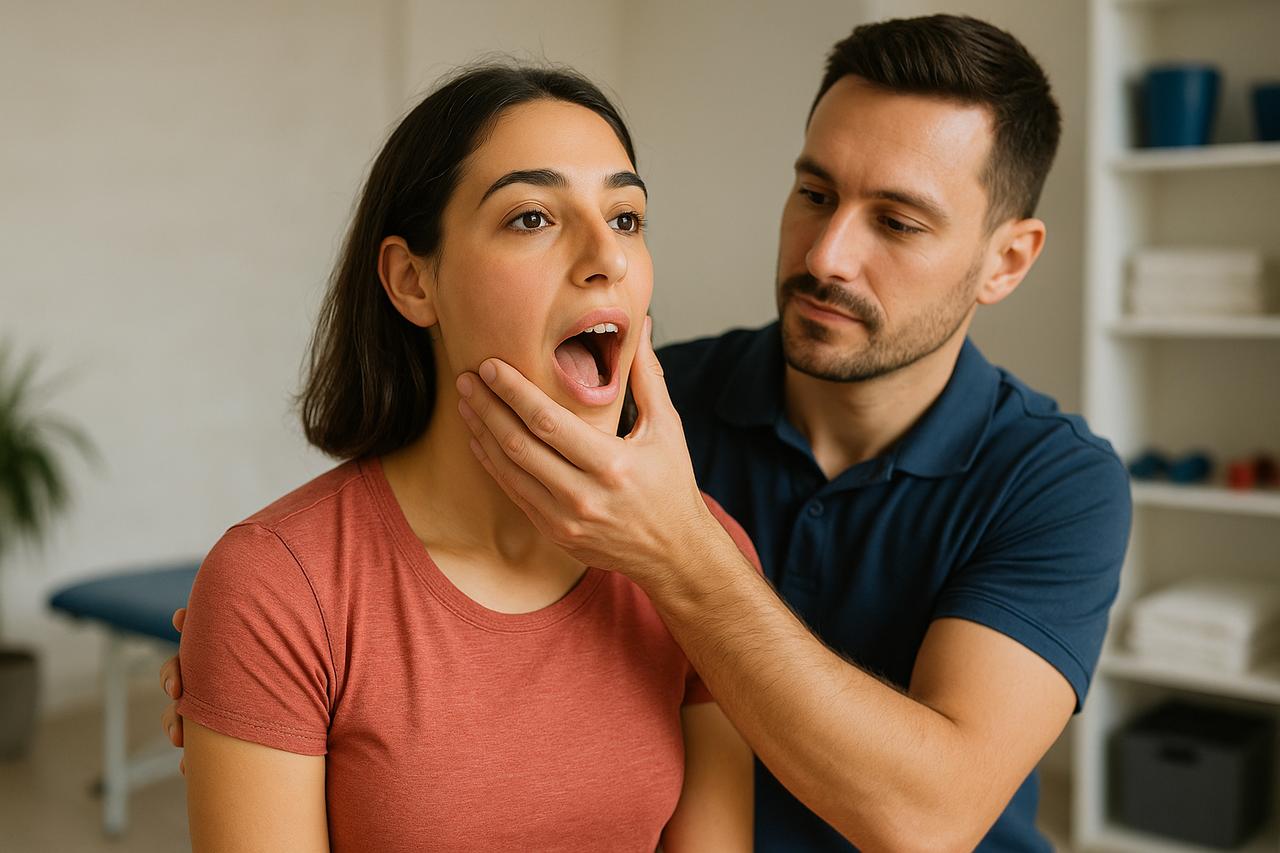
1. Resisted Mouth Opening
This exercise strengthens the muscles that open your jaw (suprahyoid and digastric muscles) against gentle resistance, helping to counteract the powerful closing muscles that are often overworked from clenching.
- Sit or stand upright with a relaxed, neutral posture.
- Place the thumb of one hand gently under your chin.
- Slowly begin to open your mouth, while simultaneously applying light upward pressure with your thumb. This creates resistance for the opening muscles.
- Hold the open position for 3-5 seconds.
- Slowly close your mouth, relaxing the pressure from your thumb.
- Repeat this 6 times for one set. Aim for 2-3 sets per day.
2. The Goldfish Exercise (Partial Opening)
Praised for its ability to promote correct joint alignment and stability, the Goldfish exercise helps re-train the hinge motion of the jaw. It's particularly useful for addressing clicking sounds associated with disc displacement.
- Place the tip of your tongue against the roof of your mouth, just behind your front teeth. Maintain this tongue position throughout the exercise.
- Place one index finger on your chin and the other on the TMJ itself (the area just in front of your ear where you feel the joint move).
- While keeping your tongue up, slowly drop your lower jaw halfway down and then close it. The movement should be a pure hinge, without the jaw jutting forward.
- Use your fingers to provide gentle feedback and ensure the movement is smooth and straight.
- Perform 6 repetitions of this exercise, aiming for 6 sessions throughout the day. For a detailed visual guide, you can refer to resources like these four exercises to help with TMJ flare ups.
Enhancing Mobility: Flexibility and Stretching Drills
Stiffness and limited range of motion are common complaints with TMD. These exercises focus on gently stretching the tight muscles and improving the joint's overall mobility.
1. Side-to-Side Jaw Movement
This movement improves the lateral (side-to-side) motion of the jaw, which is often restricted in people with TMJ disorder. It helps to gently stretch the pterygoid muscles on the sides of the jaw.
- Start with your mouth slightly open and your jaw in a relaxed, central position.
- Slowly and gently glide your lower jaw to the right as far as is comfortable. Hold for 3-5 seconds.
- Return to the center.
- Slowly glide your lower jaw to the left, holding again for 3-5 seconds.
- Return to the center. This completes one repetition. Aim for 10 repetitions daily.
2. Forward Jaw Movement (Protrusion)
This exercise helps stretch the muscles at the back of the jaw and improves the forward gliding motion of the TMJ.
- Begin with your mouth slightly open.
- Gently slide your lower jaw forward so that your bottom teeth are in front of your top teeth.
- Hold this forward position for 10 seconds, feeling a gentle stretch.
- Slowly return to the neutral starting position.
- Repeat this movement 5-10 times per session.
The Bigger Picture: Supporting Exercises and Postural Correction
Effective jaw pain treatment rarely focuses on the jaw in isolation. The position of your head, neck, and shoulders has a direct and profound impact on TMJ function. A forward-head posture, common in our screen-focused world, puts immense strain on the neck and jaw muscles. Integrating postural exercises is non-negotiable for lasting relief.
1. Chin Tucks
This is arguably the most important exercise for correcting forward head posture and alleviating strain on the TMJ.
- Sit or stand tall, looking straight ahead. Imagine a string pulling the crown of your head up towards the ceiling.
- Without tilting your head up or down, gently draw your head backward, creating a "double chin." You should feel a stretch at the back of your neck.
- Hold this tucked position for 3-5 seconds.
- Relax and return to the starting position.
- Perform 10 repetitions, several times throughout the day, especially if you work at a desk.
Pro-Tip: Set a reminder on your phone or computer to perform chin tucks every hour. This simple habit can dramatically reduce the cumulative strain on your neck and jaw muscles throughout the day.
When Exercises Need a Helping Hand: The Role of Professional TMJ Physiotherapy
While these exercises are a powerful tool, some TMJ conditions are complex and require a professional, hands-on approach for a complete recovery. If your pain is severe, persistent, or associated with significant locking, a doctor-led physiotherapy assessment is crucial. At Physio Cure Dubai, our core philosophy is to perform a root-cause diagnosis, identifying the underlying biomechanical issues contributing to your pain.
A specialized TMJ manual therapy session goes beyond exercise. Our highly trained doctors of physical therapy, like Dr. Mina Gamil, use advanced techniques to provide targeted relief:
- Joint Mobilization: Gentle, skilled movements of the jaw joint to restore its natural glide and motion.
- Soft Tissue Release: Hands-on techniques to release tension and trigger points in the overworked chewing muscles (like the masseter and temporalis).
- Dry Needling: A modern modality used to release deep, stubborn muscle knots that contribute to jaw pain and headaches.
- Patient Education: Crucial guidance on posture, habits (like avoiding chewing gum), and stress management techniques to prevent recurrence.
This holistic and evidence-based approach ensures that your treatment plan is 100% personalized. We combine hands-on therapy with a tailored exercise program to not only alleviate your current symptoms but also to build resilience and prevent future flare-ups. This is the cornerstone of effective, lasting jaw pain treatment.
Don't let jaw pain dictate your life. If you're ready to find the root cause of your discomfort, our doctor-led team is here to help. Book your comprehensive assessment for expert TMJ manual therapy at Physio Cure Dubai and start your journey to lasting relief today.
Related care at Physio Cure Dubai
Doctor-led physiotherapy under the medical direction of Dr. Mina Gamil. If anything in this article sounds like you, two of our programs are most relevant:
- Specialty hub: Orthopedic Physiotherapy
- Treatment program: TMJ and Jaw Pain Therapy
Related care at Physio Cure Dubai
Doctor-led services for what you have just read about.
Frequently Asked Questions
What is TMJ disorder?
TMJ disorder, or TMD, is not a single condition but a group of issues that affect the temporomandibular joint, which is the hinge connecting your jawbone to your skull. It can cause symptoms like jaw pain, clicking or popping sounds, difficulty chewing, headaches, and earaches.
What are the common causes of TMJ pain?
Common causes of TMJ pain include chronic teeth clenching or grinding (bruxism), arthritis in the jaw joint, a direct injury to the jaw, misalignment of the bite or joint disc, and emotional stress leading to unconscious muscle tension.
What are some effective exercises for TMJ relief?
Two effective exercises are Resisted Mouth Opening, where you apply gentle pressure under your chin while slowly opening your mouth, and the Goldfish Exercise, where you place your tongue on the roof of your mouth and drop your lower jaw halfway down and back up.
How can bad posture affect jaw pain?
Poor posture, especially a forward-head position common with screen use, puts significant strain on the neck and jaw muscles. Correcting posture with exercises like chin tucks is crucial for alleviating this strain and achieving lasting TMJ relief.
When should I see a physiotherapist for TMJ pain?
You should see a physiotherapist if your jaw pain is severe, persistent, or associated with significant locking of the jaw. A professional can provide a root-cause diagnosis for complex conditions that don't resolve with simple exercises alone.
How does Physio Cure Dubai treat TMJ disorder?
Physio Cure Dubai uses a doctor-led approach focused on root-cause diagnosis. Their treatment for TMJ is 100% personalized, combining hands-on manual therapy to restore joint function with a tailored exercise program to alleviate symptoms and prevent future flare-ups.
What advanced therapies are used for TMJ at Physio Cure Dubai?
The clinic uses advanced modalities for TMJ treatment, including Joint Mobilization to restore natural motion, Soft Tissue Release for muscle tension, and Dry Needling to release deep, stubborn muscle knots that contribute to jaw pain and headaches.
Does Physio Cure Dubai accept direct insurance billing?
No, Physio Cure Dubai operates on a "pay upfront" basis and does not offer direct insurance billing. Patients must pay for their services in full and then submit the provided invoice and medical documentation to their insurance company for reimbursement.
Who are the specialists at Physio Cure Dubai for complex musculoskeletal issues?
The clinic's clinical team includes senior practitioners specializing in complex conditions. Dr. Mina Gamil, the Medical Director, specializes in Sports Injuries and Complex Musculoskeletal Disorders, while Dr. Shaimaa Hamdalla and Dr. Talaat Abdelhakeem also manage orthopedic and postural dysfunctions.
What is the first step to getting treatment at Physio Cure Dubai?
The first stage in the patient journey at Physio Cure Dubai is a Complimentary Initial Consultation & Assessment. This is followed by a root cause diagnosis and the creation of a personalized treatment plan.
Related Articles
Acupuncture for Chronic Headaches
Break free from endless pills. Discover how doctor-led acupuncture paired with physiotherapy tackles root causes of chronic headaches for lasting relief.
14 min read

Massage Therapy for Fibromyalgia: How It Helps
Discover how specialized massage therapy interrupts pain signals, eases tension, and improves sleep for fibromyalgia relief within a doctor-led holistic plan.
13 min read

How Posture Affects TMJ Jaw Pain
Forward head posture can load the jaw, neck and chewing muscles. Learn how doctor-led TMJ physiotherapy assesses posture and treats jaw pain safely.
8 min read